Teahupoʻo.
Teahupoʻo is a village on the south-eastern coast of Tahiti, where the road ends and the lagoon passes lead out to one of the heaviest waves ridden anywhere. Wikipedia says an extremely shallow coral reef, ranging up to about 20 inches beneath the surface, is responsible for a very hollow-breaking wave with an almost below-sea-level effect. The village has a population of roughly 1,500 and a single one-lane road. For almost everyone, Teahupoʻo is a place to watch from a boat, and only a small group of surfers should consider the paddle.
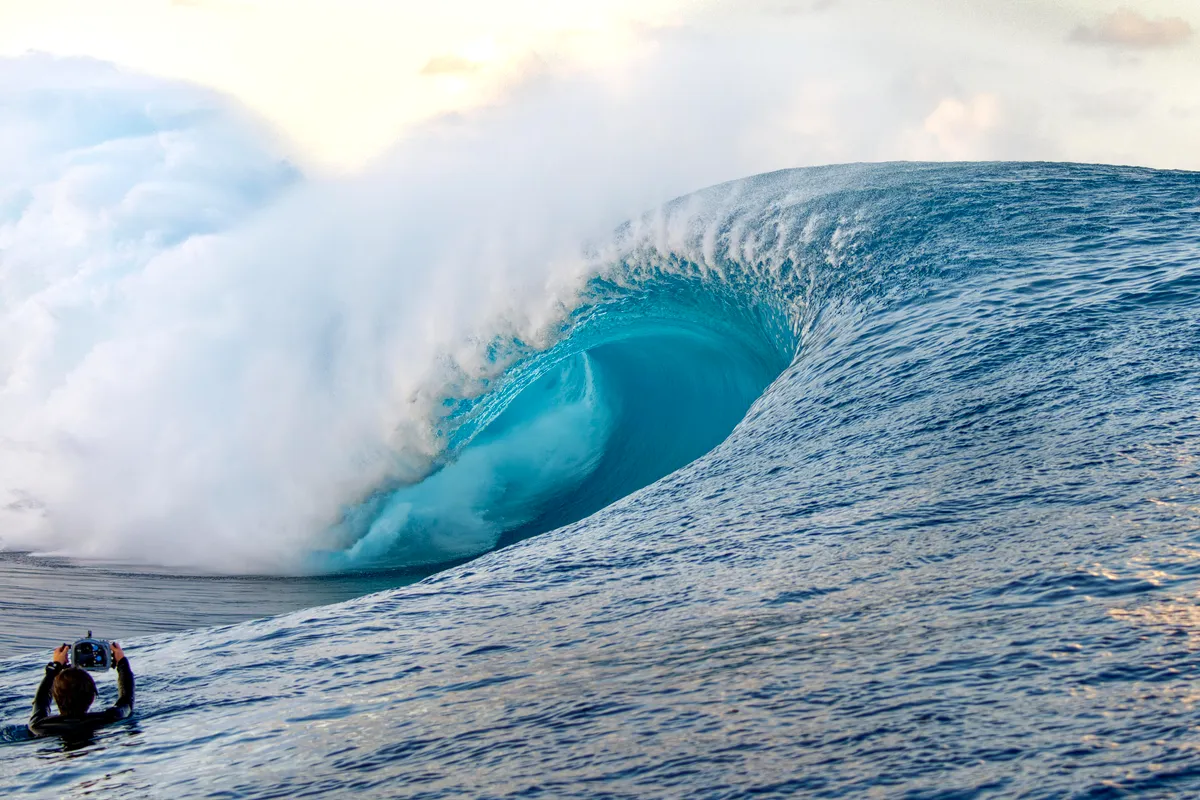 Photo: Olivier Dugornay (IFREMER) · CC BY 4.0 · Wikimedia Commons
- Level
- Expert
- Direction and bottom
- Left · Reef
- Best swell
- S to SSW groundswell
- Best wind
- NNE offshore
- Best tide
- Works at all stages; extremely shallow on the low
- Best months
- Apr, May, Jun, Jul, Aug, Sep
- Size
- Waist-high to well over double overhead; thick at every size
- Hazards
- Razor-sharp, very shallow coral, Heavy hold-downs, Boat traffic, Sea urchins, Sharks noted by Surf-Forecast, Distance from medical care
Why the wave is so unusual
The reef beneath the wave is semi-circular and drops away sharply, according to Wikipedia, and the extreme angle of descent creates instant instability as swell arrives. Instead of a gradual face that grows slowly, the wave rises abruptly, throws a thick lip and pitches into a barrel over very shallow water. Surf-Forecast lists the break as a left-hand reef rated five out of ten and very consistent, with the best swell from the south and the best wind from the north-north-east.
The wave works at all stages of the tide, but low water reduces the margin for error. The whole line-up sits close to the edge of the reef, and a wipeout means contact with coral that is sharp enough to cause deep cuts. Even the best surfers treat it with caution, and many wait for a clear sign before taking off on a set wave.
Season and size
The Tahitian surf season follows the southern hemisphere winter, with southerly swells arriving between about April and September. Surf-Forecast's guide calls winter the optimal season, while the seasonal figures name April as a strong month, with about 50 percent clean and 48 percent blown out. The water temperature is around 26 degrees Celsius, so a rash vest or light suit is typical.
The size varies a great deal. On smaller days the wave is still hollow and shallow, but the barrel can be ridden by experienced surfers. On larger days it becomes one of the most powerful waves in the world, and few people paddle out. Because the reef is close to shore, the whole display can be watched from the channel, which is why it is popular with photographers.
Who must not surf it
Teahupoʻo is an expert-only wave. Surf-Forecast lists rocks, sea urchins and sharks as hazards, and the page describes the lineup as often crowded. The reef is shallow, the waves are heavy, and the nearest serious medical care is far away. A surfer who does not have extensive experience on shallow reef, in heavy surf and with a safety team should not enter the water.
There are gentler reef passes and beaches around Tahiti, and local guides can advise on which are suitable. Visitors should not paddle out simply because they have paid for a boat. Listen to the boat driver and respect any rules about the number of boats in the channel and the distance from the lineup. Local surfers and their families have a deep connection with the wave, and the village is a community rather than a backdrop.
Getting there and watching
The village of Teahupoʻo lies at the end of the road along the south-east coast of Tahiti. Wikipedia describes a single one-lane road. Surf-Forecast lists Moorea's Temae airport about 68 kilometres away in a direct line and Huahine about 229 kilometres away; most visitors arrive at Tahiti's main airport and drive or take a transfer to the village. Allow time for road traffic and for weather.
The wave breaks offshore, so the usual way to watch is by boat from the village, with local operators offering trips when the surf is up. Choose an operator that follows safety rules, and stay in the channel rather than drifting close to the reef. Boats are exposed to swell and wind, so seasickness and spray are common. Bring sun protection, water and a waterproof bag for cameras.
History and context
Wikipedia says the name Teahupoʻo loosely translates as to sever the head or place of skulls, in reference to a battle that once took place in the village. It also notes that the village has been affected by radioactivity from a 1974 French nuclear test. Surf-Forecast lists Vairao, Faaone and Papara as nearby breaks. The Tahiti destination guide covers the wider island.
Respecting the village
Teahupoʻo is a small community, and the quiet road, the church and the neighbouring houses are part of daily life. Park considerately, keep noise down, and do not block boat ramps. Ask permission before photographing people or property. If you hire a boat, agree the price and route in advance, and follow the driver's instructions about where to sit and where to stay. Wear sun protection, and bring a waterproof bag for cameras and phones. If swell is large, expect delays or cancellations, and be prepared to watch from the shore rather than insisting on going out.
The ocean off Tahiti, by month
| J | F | M | A | M | J | J | A | S | O | N | D | |
|---|---|---|---|---|---|---|---|---|---|---|---|---|
| Swell, m | 1.7 | 1.6 | 1.7 | 1.8 | 2.2 | 2.2 | 2.2 | 2.0 | 2.3 | 2.1 | 1.8 | 1.7 |
| Period, s | 13 | 12 | 12 | 13 | 14 | 13 | 12 | 12 | 13 | 13 | 13 | 12 |
| Water, °C | 28 | 29 | 29 | 29 | 28 | 28 | 27 | 26 | 26 | 26 | 27 | 28 |
Open-ocean ERA5 medians, not wave size at the break. Sources.
Questions about Teahupoʻo
Is Teahupoʻo a left or a right?
A left. Surf-Forecast describes a left-hand reef break, and the wave is known for its thick, shallow barrel.
How shallow is the reef?
Wikipedia says it ranges up to about 20 inches beneath the surface, which is why the wave is so hollow and dangerous.
How do I watch it?
By boat from the village, using a local operator, or from the shore when the wave is close enough.
When is the best season?
The southern hemisphere winter, from about April to September, when southerly swells arrive.
Check a live forecast and local advice before paddling out. Heavy waves injure and kill experienced surfers.