Cloud 9.
Cloud 9 is the reef wave off General Luna on Siargao, an island at the north-eastern tip of Mindanao in the Philippines. Wikipedia describes it as a right-breaking reef wave known for thick, hollow tubes, found by travelling surfers in the late 1980s and named by the American photographer John Seaton Callahan after a chocolate bar. Surfer magazine featured it in March 1993. The wave is one of the clearest examples of a reef barrel that you can watch from a platform and walk to along a boardwalk, which is part of its popularity and part of its problem.
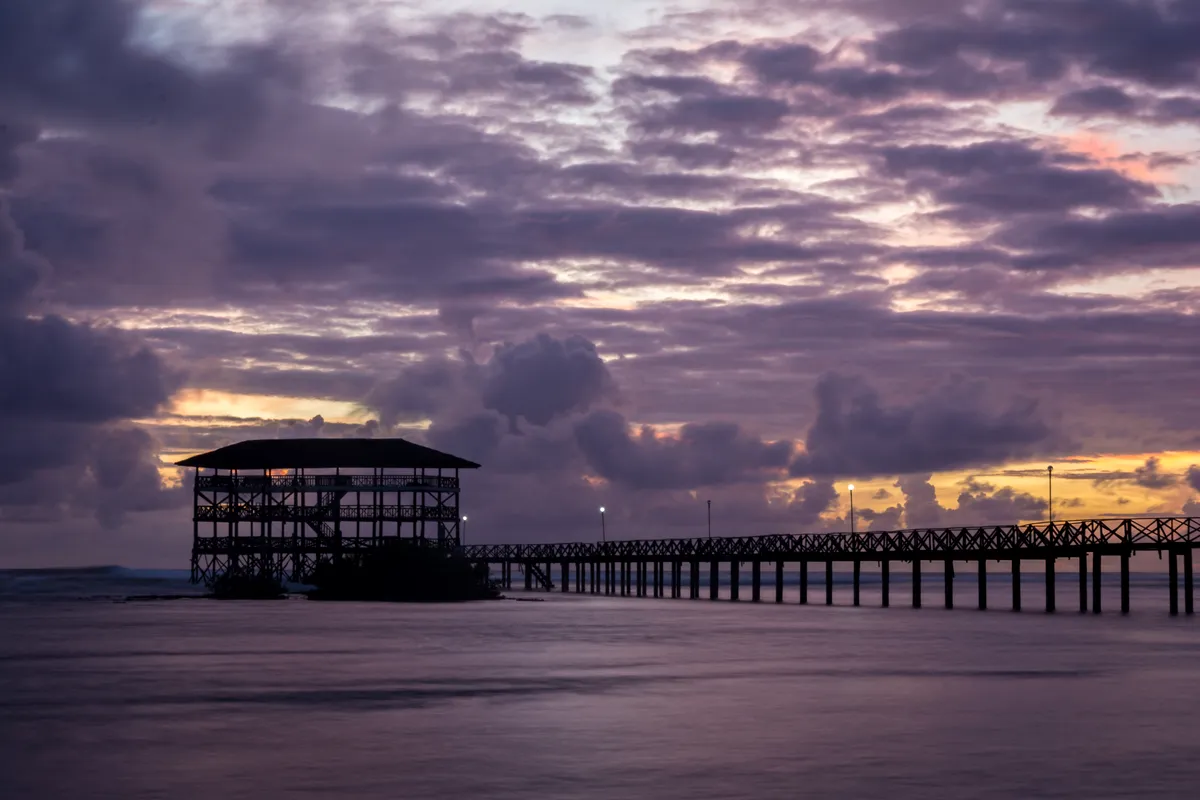 Photo: JupitReyes · CC BY-SA 4.0 · Wikimedia Commons
- Level
- Advanced
- Direction and bottom
- Right · Reef
- Best swell
- NE (typhoon and Pacific swell)
- Best wind
- SW offshore
- Best tide
- Rising to high; low tide is shallow and dangerous
- Best months
- Sep, Oct, Nov, Dec, Jan, Feb, Mar
- Size
- Waist-high to double overhead; thick and hollow from head-high
- Hazards
- Shallow reef at low tide, Rip currents, Rocks and sharp coral, Crowds, Typhoon season
Thick, hollow and shallow
Surf-Forecast lists Cloud 9 as an exposed reef break with right and left waves, rated four out of ten and fairly consistent. The bottom is mossy reef with the occasional rock, and low tide is shallow and dangerous in places. The best conditions are around high tide while the water is rising, which gives the wave a little more depth without taking away its shape.
The best swell direction is north-east, and windswells are more common than groundswells. The best wind is south-west offshore. When the wave works, it throws a thick lip over the reef and forms a barrel that runs for some distance. On smaller days it is less intense, and the platform and the pier give access for people who want to practise on the inside.
Season and crowds
Wikipedia says Siargao's surf season runs from August to December, during the south-west monsoon, while Surf-Forecast cites autumn and winter as optimal and a review gives September to March, with November and December the strongest months. The page's statistics put September as the best month for clean waves, at about 60 percent of the time. The water temperature is about 30 degrees Celsius, so a rash vest is enough.
Crowds are a feature. Surf-Forecast says the spot is unlikely to be crowded in one place and describes heavy crowds in a review, where it is nicknamed Crowd 9. Wikipedia repeats the nickname, noting overcrowding caused by popularity. Plan to surf early, be patient and wait your turn. Typhoons can also affect the island, and Wikipedia records that Typhoon Odette, known internationally as Rai, struck on 16 December 2021 as a Category 5 super typhoon and caused severe damage.
Who should not surf Cloud 9
Cloud 9 is not a beginner wave. The reef is shallow, and Surf-Forecast warns of dangerous rip currents, shallow reef at low tide and rocks on the reef. Booties are optional on the page but can help, particularly when walking over the reef. Visitors who do not know how to read a lineup or who struggle with a late takeoff should stay on the platform and watch.
If you want to learn, there are gentler breaks around General Luna and on other parts of Siargao, with schools that can match you to the right wave. Surf-Forecast lists Tuason Point, Horseshoe, Pancit Reef, Stimpy's and Barrio within about seven kilometres. Always check the tide before you go, and avoid the reef at low tide unless you know exactly what is under the surface.
Getting there and watching
Sayak Airport has had direct flights from Manila since March 2017 and from Clark since July 2018, according to Wikipedia, and other flights link the island with Cebu. Before the direct flights, travellers flew to Surigao City and took a ferry. Check current schedules, since airlines and routes change.
Surf-Forecast says the break is easily reached without a boat, with a pier and a tower on the shore that help with paddling or walking out. The boardwalk and the tower give a close view of the wave, and many visitors watch the sessions from there. Be careful on the wooden steps and wet planks, and do not leave belongings unattended. Show respect for local customs and the businesses along the road.
The wider island
Siargao has many other breaks, beaches and lagoons, and the destination guide for Siargao covers lodging, lessons and getting around. This page sticks to the wave at Cloud 9 itself.
Reading the tide and the platform
The boardwalk and the pier are part of the experience at Cloud 9, but they also shape behaviour in the water. Surfers often paddle out from the end of the pier, and the channel beside the reef can have a strong current on a rising tide. Check the tide table the evening before, and pick a session that avoids dead low water. If you are unsure about a section, wait on the shoulder and observe how others use the reef. After a surf, rinse any cuts with clean water and treat them quickly, because tropical conditions encourage infection. Respect the local surf community, and remember that the busiest hours are usually mid-morning when the tide fills in.
The ocean off Siargao, by month
| J | F | M | A | M | J | J | A | S | O | N | D | |
|---|---|---|---|---|---|---|---|---|---|---|---|---|
| Swell, m | 1.8 | 1.5 | 1.3 | 1.1 | 0.9 | 0.7 | 0.7 | 0.7 | 0.7 | 1.0 | 1.2 | 1.5 |
| Period, s | 10 | 9 | 9 | 9 | 9 | 9 | 9 | 10 | 10 | 11 | 9 | 10 |
| Water, °C | 28 | 28 | 28 | 29 | 30 | 30 | 30 | 30 | 30 | 30 | 29 | 29 |
Open-ocean ERA5 medians, not wave size at the break. Sources.
Questions about Cloud 9
Why is it called Cloud 9?
Wikipedia says American photographer John Seaton Callahan named it after a chocolate bar.
When should I go?
The surf season runs from about August to December on Wikipedia's account, with Surf-Forecast citing September to March.
Is it dangerous?
It can be. Low tide is shallow, rips run along the reef, and the crowd can be heavy. Choose your tide carefully.
How do I get to Siargao?
By direct flight to Sayak Airport from Manila or Clark, or via Cebu, according to Wikipedia. Check the current schedule.
Check a live forecast and local advice before paddling out. Heavy waves injure and kill experienced surfers.