The breaks
Recognised, publicly known surf spots around Nias. Suitability depends on the day's swell, wind and tide, so treat the level as a guide, not a guarantee.
| Break | Type | Best for | Notes |
|---|---|---|---|
| Lagundri Bay (The Point) | Right-hand reef point | Intermediate–Advanced | The island's famous wave, a long, fast right over shallow coral with a tight take-off. Best on a medium swell with careful tide timing. |
| Sorake beach break | Beach break | Beginner–Intermediate | A quieter beach break on the Sorake side of the bay, used by learners and by surfers wanting a gentler session away from the main peak. |
| Rockstar Point | Right-hand reef | Intermediate | A fast right over coral described in Indonesian tourism coverage as an intermediate wave. Ask locally about tide and access before paddling out. |
| Asu (Hinako Islands) | Reef break | Intermediate–Advanced | A consistent reef wave in the Hinako Islands off the west coast. It needs a boat and organised logistics, so plan it with where you are staying. |
| Bawa (Hinako Islands) | Reef break | Intermediate–Advanced | The second well-known Hinako wave, reached by boat. Distance from the bay and swell direction make it a planned trip rather than a casual session. |
Full profile: Lagundri Bay.
Nias surf climate, measured
Ten years of ocean model data for the open water off this coast: what the swell usually looks like before it reaches the beach. Shelter, sandbars and reefs change what you actually surf, so read this next to the month notes below.
| Month | Swell | Period | From | Wind | Water | Wetsuit | Days over 2.5 m |
|---|---|---|---|---|---|---|---|
| Jan | 1.2 m | 13 s | SW | 11 km/h W | 29°C | Boardshorts | 0% |
| Feb | 1.1 m | 12 s | SW | 9 km/h W | 30°C | Boardshorts | 0% |
| Mar | 1.2 m | 13 s | SW | 9 km/h W | 30°C | Boardshorts | 0% |
| Apr | 1.3 m | 14 s | SW | 9 km/h SW | 30°C | Boardshorts | 0% |
| May | 1.5 m | 15 s | SW | 8 km/h W | 30°C | Boardshorts | 0% |
| Jun | 1.5 m | 14 s | SW | 8 km/h NW | 30°C | Boardshorts | 0% |
| Jul | 1.6 m | 15 s | SW | 8 km/h S | 30°C | Boardshorts | 3% |
| Aug | 1.7 m | 15 s | SW | 9 km/h SW | 30°C | Boardshorts | 3% |
| Sep | 1.5 m | 14 s | S | 11 km/h S | 29°C | Boardshorts | 0% |
| Oct | 1.4 m | 15 s | SW | 11 km/h NW | 29°C | Boardshorts | 0% |
| Nov | 1.3 m | 13 s | SW | 12 km/h NW | 29°C | Boardshorts | 0% |
| Dec | 1.2 m | 13 s | SW | 12 km/h W | 29°C | Boardshorts | 0% |
Median values from ERA5 at a sea point near Nias (0.5°N, 97.75°E), sampled 4 days a month at 12:00 UTC, 2015-2024. Highlighted months are our suggested planning window. Not a forecast or a safety assessment. How we use this data.
Book a surf trip to Nias
Everything we can link you to for this trip, grouped by what you need. Before you pay a camp or school, read who holds your money, and check that your insurance covers surfing.
Where to stay
Search near the breaks. Filter for surf hostels, apartments or hotels once you can see the map.
Surf lessons and activities
Listings change by season, so check what the operator includes and who coaches.
Flights
Add your dates and check the board fee on every leg before you pay.
Car hire
Ask about roof racks and whether the insurance covers boards on the roof.
Airport transfer
Tell the driver you have a board and its length when you book.
Scooter or motorbike
Check your licence and your insurance cover before you ride.
Mobile data
Download a forecast app and offline maps before you land.
Flight delay claims
If a delay eats your first surf day, check whether you can claim.
Luggage storage
Useful between check-out and a late flight. Check the size limit before dropping a board.
Links marked as partner links may earn us commission at no cost to you; the rest earn us nothing. We have not checked live availability or price, and the seller's terms apply. How we handle this.
An island off Sumatra's west coast
Nias sits in the Indian Ocean off the west coast of Sumatra, in North Sumatra province, and has a population of roughly 950,000 people. Its largest town is Gunungsitoli on the north-east side, and the surf is on the opposite end, at the southern tip near the town of Teluk Dalam. The two places are linked by a road that takes several hours.
The island has an unusual cultural identity. Traditional villages in the south and centre, such as Bawomataluo, are known for stone architecture, carved wooden houses built on ironwood pillars and old traditions including stone jumping. Some researchers describe Nias culture as one of the last living megalithic cultures, although that label is debated. Surfers who spend a few days off the water will find the villages worth visiting.
Nias is also an earthquake zone. The 2004 Indian Ocean tsunami and the large earthquake of March 2005 both affected the island, and the coastline changed in places. Rebuilding has been gradual. Surf travel resumed afterwards and the main bay again has places to stay, but you should expect simple, modest infrastructure rather than resort comfort.
Lagundri Bay and the wave surfers come for
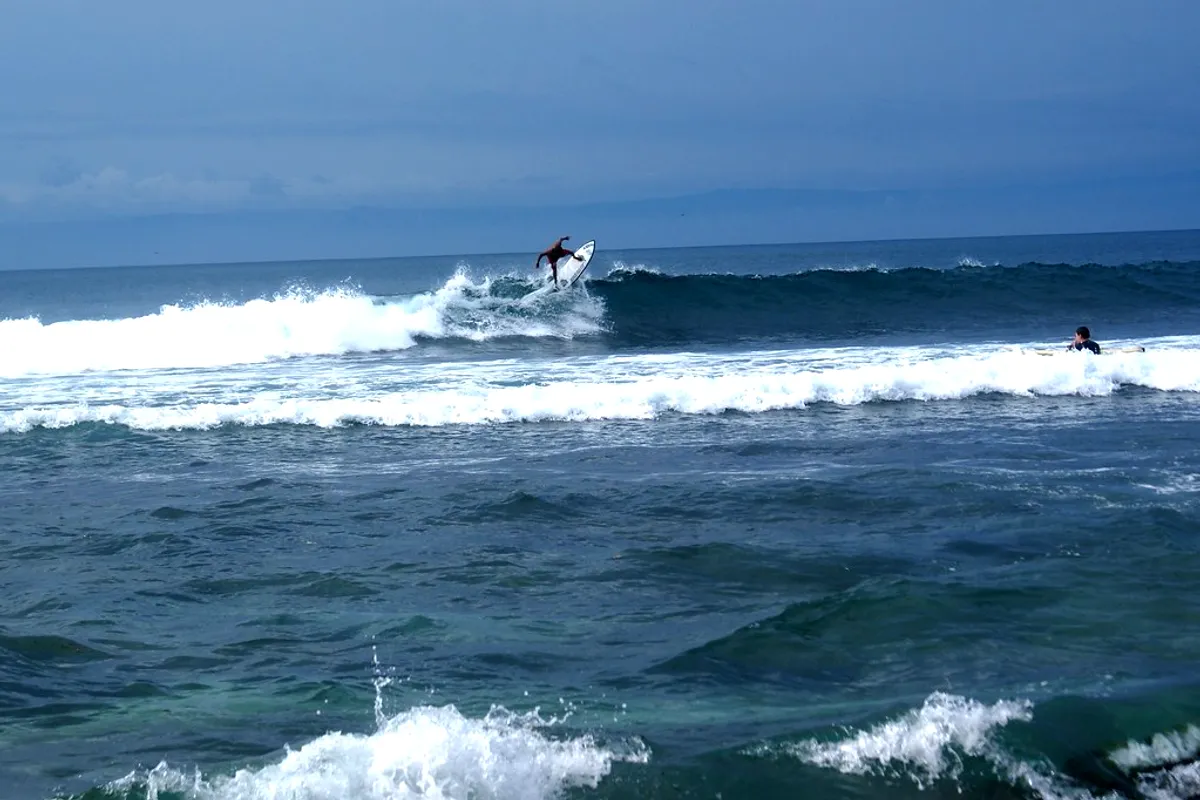
The surfing centres on a bay formed between Sorake beach and Lagundri beach. The headline wave is a right-hand reef break, usually called The Point, that peels across a shallow platform of rock and coral. Surf writers describe it as one of the most perfect rights in Indonesia, and it has been ridden since the mid-1970s, when travelling Australian surfers are generally credited with discovering it.
The wave works on a broad range of swell sizes. On smaller days it is an accessible, fast-running right with a short barrel section. On bigger days the whole bay lights up, the take-off zone moves wide and the wave becomes serious. Because the line-up is tight and the best part of the wave is close to shallow reef, it is best for confident intermediates and above. Lesser surfers can enjoy the small days, but should choose their moments carefully and be patient about taking turns.
Sources disagree on a few details of the bay, so treat any single description with caution. Some older write-ups mention a left as well as the famous right; the main wave that visitors travel for is the right. Check what the locals and your accommodation tell you about the current state of the tide and reef.
Other waves around the southern coast
Beyond The Point there are several other breaks within reach. A beach break on the Sorake side of the bay is quieter than the main take-off and used by learners and by anyone who wants an easier session. Rockstar Point is described in Indonesian tourism coverage as a fast right over coral, again aimed at intermediate surfers.
Further out, the Hinako Islands, off the west coast, have two well-known waves, Asu and Bawa. These need a boat and a plan; they are not day trips from the bay, and they are best arranged through the place where you are staying. Distances at sea and swell direction matter here, so do not improvise.
The practical advice is to treat Lagundri Bay as the base and add outer breaks only if you have time, a decent budget and the right swell. Most visitors find that the main bay offers plenty.
When the swell comes to Nias
Most sources agree that the best period runs from roughly April or May to October. In this window the Indian Ocean produces regular southern hemisphere swell and the winds are often favourable. Several guides give May to October as the peak, though some write April to October, so the edges are soft.
The wet season, roughly November to March, brings rain, more unsettled weather and smaller, less reliable surf on average, although the island can still produce waves. Many visitors time their trip between June and September for the most consistent swell, and that is when you should expect the largest number of other surfers, including organised groups.
There is no useful rule that replaces checking a forecast on the day. Tide matters at a reef wave: ask where you are staying about the tide and the reef conditions before you commit to a session.
Getting to Nias, and onwards to the bay
Most travellers fly into Binaka Airport at Gunungsitoli. Flights come from the Sumatran mainland and other Indonesian airports, and routes and operators change, so check current timetables. From Gunungsitoli the drive south to Sorake and Lagundri takes about four hours on a road that can be slow. Many accommodation providers arrange transfers, and it is sensible to book one rather than look for transport on arrival.
It is also possible to reach the island by sea from Sibolga on mainland Sumatra, but the ferry timing is slower and less predictable. Allow buffer days either side of any international flight home, because delays in flights and roads are common in remote Indonesia.
Inside the bay, almost everything is walkable. A scooter helps for trips to nearby villages and the town of Teluk Dalam. Bring enough cash for the stay, as digital payments and cash machines may be less reliable than on Bali.
Where to stay and what to expect on the ground
Accommodation is concentrated on the Lagundri and Sorake sides of the bay, in a mix of homestays, simple guesthouses and surf-oriented lodges. Nearly all of it is close to the water and within walking distance of the wave. Do not expect nightlife; evenings usually involve a simple meal, conversation and an early night to be up for the morning session.
Food is basic and often fish, rice and vegetables. The island has a distinct local culture. Dress respectfully away from the beach and ask before photographing people in the villages.
Because the island is remote, bring what you cannot easily replace: spare fins and leash, wax, sun protection, a basic first-aid kit and any medication you need. Check current travel health advice for malaria and other tropical infections before you go.
Respect, safety and the realities of a reef point
The reef is the principal hazard. Coral and rock lie close to the surface at low tide, cuts can become infected quickly in tropical water and medical help is a long way off. Wear reef shoes if you are not used to shallow reef, clean every cut properly and do not ignore minor wounds.
The line-up can be crowded and, at times, tense. Take turns, avoid dropping in and understand that the best part of the wave is a short running section. Local people live and work around the bay, so treat the line-up and the village with respect.
In a seismic region it is also worth asking your accommodation about the tsunami plan and the route to higher ground. It is a small piece of preparation that is easy to ignore until it matters.
Nias surf season month by month
A broad planning picture, not a forecast. Swell, wind and water temperature vary from year to year.
| January | Wet season, with rain, unsettled weather and less consistent swell. Some days can work, but this is not the month to build a trip around. |
|---|---|
| February | Still in the wet season, often small and variable. Quiet for crowds and cheaper accommodation if you are happy to take what the ocean gives. |
| March | Rain continues and swell is patchy, though the transition towards the drier months begins. |
| April | A shoulder month. Some guides place the start of the season here, with swell building and fewer visitors than mid-year. |
| May | The season is starting. Regular southern hemisphere swell reaches the bay and crowds are still moderate. |
| June | Peak season begins, with consistent swell and typically better winds. The take-off at The Point gets busier. |
| July | One of the most reliable months, and often the busiest. Expect organised groups at the main wave and book accommodation early. |
| August | Another peak month with regular swell. Reef is more exposed at low tide on smaller days, so plan around the tide. |
| September | Still a good month, with swell consistency continuing and slightly thinner crowds than July and August. |
| October | The tail of the season. Waves can still be good, though rain becomes more likely and the bay quietens down. |
| November | The wet season returns. Swell is less reliable and weather more changeable; fewer surfers make the bay calm. |
| December | Wet and unsettled. The month of the 2004 tsunami anniversary; a quiet, wet time on the island with few visitors. |
Learning to surf on Nias
Nias is not a beginner destination. The famous wave is a shallow-reef right with a crowded take-off, and the island has far fewer surf schools than Bali or Java. If you have never surfed, a more forgiving place such as Batu Karas or Canggu is a better starting point.
Intermediate surfers who can already paddle into green waves, control their board and read a line-up will get the most from the trip. The quieter beach break on the Sorake side can be used to warm up or to practise, but ask locally about currents and tide before you go out. Do not rely on finding a formal lesson on arrival; if you want coaching, arrange it in advance through the place you plan to stay.
Comparing options across the country? Read our guide to surfing in Indonesia.
Seasonal notes on this page describe typical patterns, not the conditions on a given day. Use the local forecast, lifeguard advice and a qualified instructor for water-safety decisions, and get a written breakdown of what any surf package includes before paying.
Nias surf trip questions
When is the best time to surf in Nias?
Most guides point to roughly May to October, when southern hemisphere swell is most consistent and winds are generally better. July and August are usually the busiest months. The wet season from November to March can still produce waves but is less reliable.
How do you get to Lagundri Bay?
Fly to Binaka Airport at Gunungsitoli, which has domestic connections, then travel by road to Sorake and Lagundri. The drive takes around four hours on a slow road, and transfers are usually arranged by accommodation. Check current flight schedules before you book.
Is Nias suitable for beginners?
Not really. The main wave is a shallow reef right with a tight take-off. A quieter beach break exists on the Sorake side, but the island has limited lesson infrastructure. Beginners are better served by Batu Karas or Bali.
What are the main dangers when surfing in Nias?
Shallow coral and rock are the main hazards, with cuts that can become infected and medical help a long way away. The line-up can also be crowded. The island is seismically active, so ask your accommodation about its tsunami plan.
What is there to do on Nias besides surf?
Traditional villages such as Bawomataluo are known for stone architecture and carved wooden houses, and the Museum Pusaka Nias in Gunungsitoli covers local culture. Both are reachable by road, although journeys take time.
Sources & editorial notes
Destination context checked against the sources below. Base-selection and itinerary suggestions are Book & Surf editorial recommendations. Seasonal windows are broad planning suggestions, not measured forecasts or guarantees.
We do not claim to have personally surfed every break. Read our editorial standards.