Ribeira d'Ilhas.
Ribeira d'Ilhas is a wide bay a few minutes north of Ericeira town, and the wave that peels along its northern side is one of the easiest world-class rights to watch and to understand. It is part of the Ericeira World Surfing Reserve, which Wikipedia describes as one of only two European locations with that status, and it is the break most surfers choose for a first proper session in the area. It is also the busiest, which is the main fact to hold in your head before you paddle out.
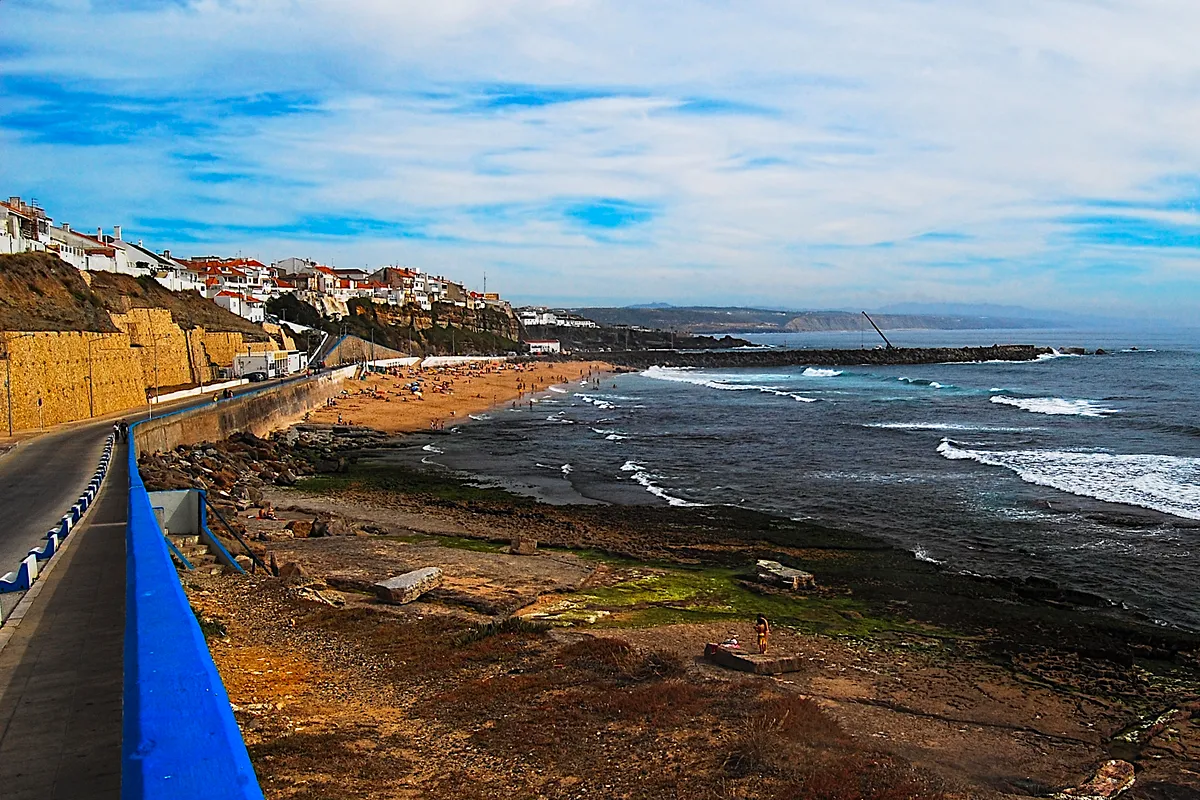 Photo: Juntas · CC BY-SA 4.0 · Wikimedia Commons
- Level
- Intermediate
- Direction and bottom
- Right · Reef
- Best swell
- WNW
- Best wind
- SE offshore
- Best tide
- Works at all stages
- Best months
- Oct, Nov, Dec, Jan, Feb, Mar
- Size
- Knee-high to head-high is the sweet spot; double overhead gets hard
- Hazards
- Rocks in the lineup, Crowds, Strong inside current on bigger days
The wave in detail
Surf-Forecast describes Ribeira d'Ilhas as an exposed reef break with a right-hand reef wave and some beach-break peaks inside the bay. The take-off area sits over rock, and the wave then runs along the point towards the inside, where it softens and splits into smaller sections. Ride length is the attraction. On a decent west-north-west swell the face has enough shape to link several manoeuvres, and the inside is gentle enough that many surfers finish a wave comfortably rather than being thrown onto rocks.
The reef is not as heavy as Coxos or Cave, which are the nearby breaks the same page lists at one kilometre or less. That is why Ribeira d'Ilhas is a stepping stone: the wave is serious enough to reward good surfing and forgiving enough that an intermediate who picks the right size can enjoy it.
When it works
The page rates Ribeira d'Ilhas as working throughout the year, with December the strongest month. In December about 41 percent of the time is clean, about 56 percent is blown out and only about 3 percent is too small. That balance explains why the wave is productive but wind-limited: the Portuguese north wind can ruin an otherwise solid day, so the south-east morning offshore is the setup to look for. The tide barely matters, since the spot works at all stages.
Summers bring smaller surf and the easiest conditions, with fewer sets that overwhelm the inside. The sea temperature on Surf-Forecast is about 17 degrees Celsius, so a spring or full wetsuit is the norm. In winter, expect a thicker suit and a cold wind on the walk back across the car park.
Who should not surf it
Skip Ribeira d'Ilhas if you cannot yet control your board in a crowded lineup, if you are learning to paddle into green waves or if you are not comfortable being close to rocks. Surf-Forecast lists rocks in the lineup as the main hazard, and the crowd is likely whenever the surf is up. A beginner's wipeout in a lineup this busy affects other people, so learners are better placed at a sandy beach with a school.
On very large days the inside current grows, the sets stack up and the wave stops being friendly. The reserve is known for waves that break in several places at once, but this is not the day to improvise. Ericeira has quieter options for those who want a safer session, and the town's locals tend to be fair to surfers who show patience and respect.
Getting there and where to watch
The bay lies just north of Ericeira and is a few minutes from the town centre by car, bike or a sustained walk. Lisbon airport is about 34 kilometres away on Surf-Forecast's figure, which is why Ericeira works so well as a surf trip combined with a city break. Parking exists above the bay, and the viewpoint on the headland is the obvious place to read the waves before getting in.
From the clifftop you can see the whole line from the outside takeoff to the inside, and you can judge how many people are in the water. The beach itself is small and rocky, and the walk to the water is short. Time your session around the crowd as well as the tide: the first light often has fewer surfers than the middle of the day.
Nearby alternatives
Several waves sit within a few minutes. Cave, Coxos, Crazy Left, Pedra Branca and a reef known simply as Reef are all within one kilometre according to the same source. They are mostly harder and shallower than Ribeira d'Ilhas, so choose them with care. The wider Ericeira guide covers the town beaches, the beginner options and what to do when the north wind blows.
The ocean off Ericeira, by month
| J | F | M | A | M | J | J | A | S | O | N | D | |
|---|---|---|---|---|---|---|---|---|---|---|---|---|
| Swell, m | 2.6 | 2.5 | 2.8 | 1.8 | 1.7 | 1.4 | 1.4 | 1.4 | 1.5 | 1.8 | 2.0 | 2.0 |
| Period, s | 13 | 14 | 13 | 11 | 10 | 9 | 9 | 9 | 11 | 12 | 12 | 13 |
| Water, °C | 14 | 14 | 14 | 15 | 16 | 17 | 17 | 17 | 18 | 17 | 17 | 16 |
Open-ocean ERA5 medians, not wave size at the break. Sources.
Questions about Ribeira d'Ilhas
Is Ribeira d'Ilhas a left or a right?
It is a right-hand reef break. Surf-Forecast also lists some beach-break peaks inside the bay, but the famous wave is the right that peels along the northern side.
Is it suitable for intermediates?
Yes, on small to medium days. The reef is forgiving compared with nearby Coxos, but rocks and crowds mean you should be confident taking off on a moving wave and controlling your board.
What is the best swell and wind?
West-north-west swell with a south-east offshore wind, according to Surf-Forecast. The tide is not a major factor because the spot works at all stages.
How far is it from Lisbon airport?
About 34 kilometres on Surf-Forecast's figure, and a short drive from Ericeira town, which makes it practical for a short trip.
How can I avoid the worst of the crowd?
Go early, choose a weekday, and paddle out beside the main peak rather than across it. Look at the whole lineup from the headland first. If it is too busy, try other waves nearby, but choose them with care because several are heavier and shallower than Ribeira d'Ilhas.
Check a live forecast and local advice before paddling out. Heavy waves injure and kill experienced surfers.