Supertubos.
Supertubos is the beach break at Peniche that gave Portugal its place on the world tour calendar. The name is Portuguese for Supertubes, and it describes what the wave does when the sand is right: it throws a thick, fast barrel that breaks hard onto a shallow bank. Wikipedia notes that the wave only reached wide international attention with the 2009 Rip Curl Pro Search event, and that it now hosts the MEO Pro Portugal stop of the World Surf League championship tour. For visiting surfers the hype is reasonable and the difficulty is real: this is a place for people who are already comfortable in powerful, shallow-bottomed surf.
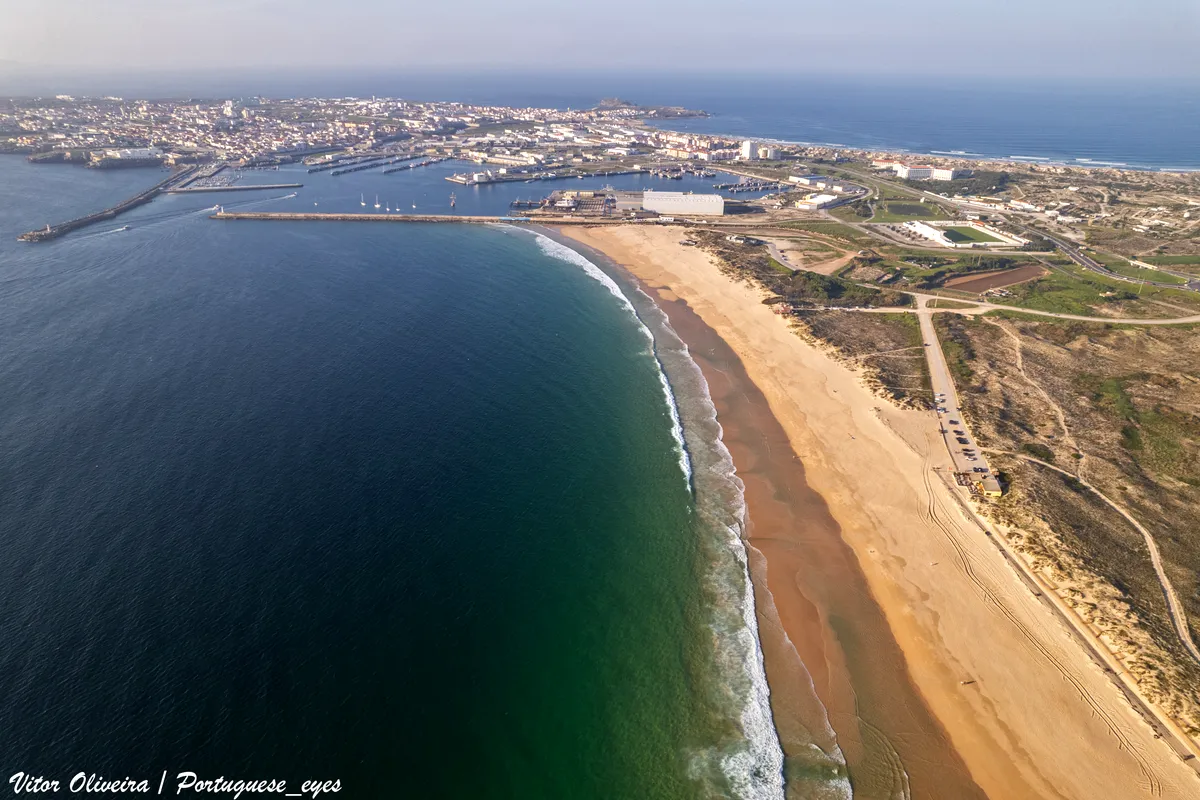 Photo: Vitor Oliveira from Torres Vedras, PORTUGAL · CC BY-SA 2.0 · Wikimedia Commons
- Level
- Advanced
- Direction and bottom
- Both · Mixed
- Best swell
- W–SW, with a long period
- Best wind
- NE–E offshore
- Best tide
- Low to mid, depending on the banks
- Best months
- Oct, Nov, Dec, Jan, Feb, Mar
- Size
- Waist-high to double overhead; best when clean and head-high
- Hazards
- Fast, shallow barrels, Crowds at peak, Rips beside the banks, Cold Atlantic water
Why the wave is so good
Peniche sits on a rocky peninsula that was once an island, and the sand around it moves a great deal. At Supertubos the sand collects in banks just off the beach, and a reef section helps to hold the shape. When the banks line up, swell arriving from the west or south-west stands up quickly and pitches, giving a barrel on both the left and the right. Surf-Forecast classes it as a beach and reef break and rates it among the better waves of the region.
The wave rewards fast takeoffs and quick decisions. A late drop that would be merely uncomfortable at a point break can mean a heavy wipeout on a bank only a metre or two deep. Because the banks shift after storms, a good season for Supertubos is as much about the sand as the swell. Local surfers know which weeks are working, which is one reason the contest organisers hold their event in the autumn, when the banks have usually had time to settle.
Conditions and seasons
Surf-Forecast gives the best swell as south-west and the best wind as north-east, and it calls the spot reasonably exposed. That exposure is the reason it receives more swell than most of the Portuguese coast, and the reason it can be large. In February, the statistics on the same page show only about 4 percent of the time as clean, 8 percent as blown out and a remarkable 88 percent as too small for most surfers, which suggests the best days are rare and are worth planning around rather than expecting.
Winter is the main season, and the heavy autumn and early winter swells often arrive with offshore mornings. In summer the surf is mostly small and the crowd is made up of learners and longboarders at the quieter ends of the beach. The sea temperature on the page is about 16.5 degrees Celsius, so a full wetsuit is standard for most of the year and boots are common in winter.
Who should not surf Supertubos
Do not paddle out here if you are still learning to duck-dive, if you cannot make a dependable late takeoff, or if you are not confident swimming in broken surf. The wave closes out in sections, the banks are shallow, and people who fall in the wrong place can hit the bottom. There are also rips running alongside the banks, and when a big set arrives the whole beach can turn into a washing machine.
The lineup is often crowded when the swell is up, and Surf-Forecast notes that the crowd can become dangerous. That matters because leashes and loose boards fly in a lineup this tight. Surfers who do not know the right of way or who drop in on others will be treated as a risk. If you want an introduction to Peniche waves, the beaches with softer breaking sections on the Baleal side are better places to start.
Getting there and where to watch
Supertubos is on the south-west side of the Peniche peninsula, a short drive or cycle from the town. Lisbon airport is about 65 kilometres away on Surf-Forecast's figure, and most visitors arrive by hire car or a bus connection. Parking at the beach fills quickly during contest week and at weekends in winter, so arrive early or park in town.
The best way to watch is from the walkway and dunes above the beach. From there you can see the sets forming, how the banks are working and how many surfers are in the water. During the world tour event a temporary viewing area appears on the sand. Watching for fifteen minutes before deciding whether to surf is a habit worth keeping at any serious beach break, and here it is especially useful.
Alternatives close by
Surf-Forecast lists several breaks within a few kilometres. Molho Leste is a sandbar break just one kilometre away, Mini Pipe and Baleal Sul are two kilometres away, and Consolacao Lefts and Consolacao Rights offer reef and point options when the wind or swell direction is wrong for the main beach. Peniche is known for giving a choice, since the peninsula faces both north and south, and a skilled local can usually find a rideable spot even when Supertubos itself is closing out.
The destination guide for Peniche covers where to stay, how to choose a school and what the town offers away from the beach.
The ocean off Peniche, by month
| J | F | M | A | M | J | J | A | S | O | N | D | |
|---|---|---|---|---|---|---|---|---|---|---|---|---|
| Swell, m | 2.7 | 2.7 | 2.9 | 1.9 | 1.8 | 1.5 | 1.5 | 1.4 | 1.5 | 1.9 | 2.1 | 2.1 |
| Period, s | 13 | 14 | 13 | 11 | 10 | 10 | 9 | 9 | 11 | 12 | 12 | 13 |
| Water, °C | 15 | 14 | 14 | 15 | 16 | 17 | 18 | 18 | 18 | 17 | 17 | 16 |
Open-ocean ERA5 medians, not wave size at the break. Sources.
Questions about Supertubos
Is Supertubos a left or a right?
Both. The banks can produce a left and a right peak depending on the sand, and the shape of the barrel changes with the swell direction and the tide. Look at how the locals are lining up before you choose a peak.
Can beginners surf Supertubos?
No. It is a powerful, shallow beach and reef break with fast barrels and often a crowded lineup. Beginners should learn on gentler beaches in the Peniche area and watch the main break from the dunes.
What is the best time of year?
Autumn and winter bring the swells that make Supertubos work. The WSL event is held when the banks are usually settled. Summer surf is mostly small and not typical of the wave's reputation.
How far is Supertubos from Lisbon airport?
About 65 kilometres by Surf-Forecast's figure. The drive is generally under an hour and a half in normal traffic, but check the road situation on a contest week or a summer weekend.
Check a live forecast and local advice before paddling out. Heavy waves injure and kill experienced surfers.