Praia do Norte (Nazaré).
Praia do Norte means North Beach, and it is the stretch of sand beside the lighthouse headland at Nazaré where waves of unusual size appear in winter. Wikipedia says the height comes from an underwater canyon that creates constructive interference between incoming swell waves, and Guinness World Records has listed Nazaré for the biggest wave ever surfed. For almost everyone reading this page, Praia do Norte is a place to watch rather than to surf, and the useful question is how to watch it well and safely.
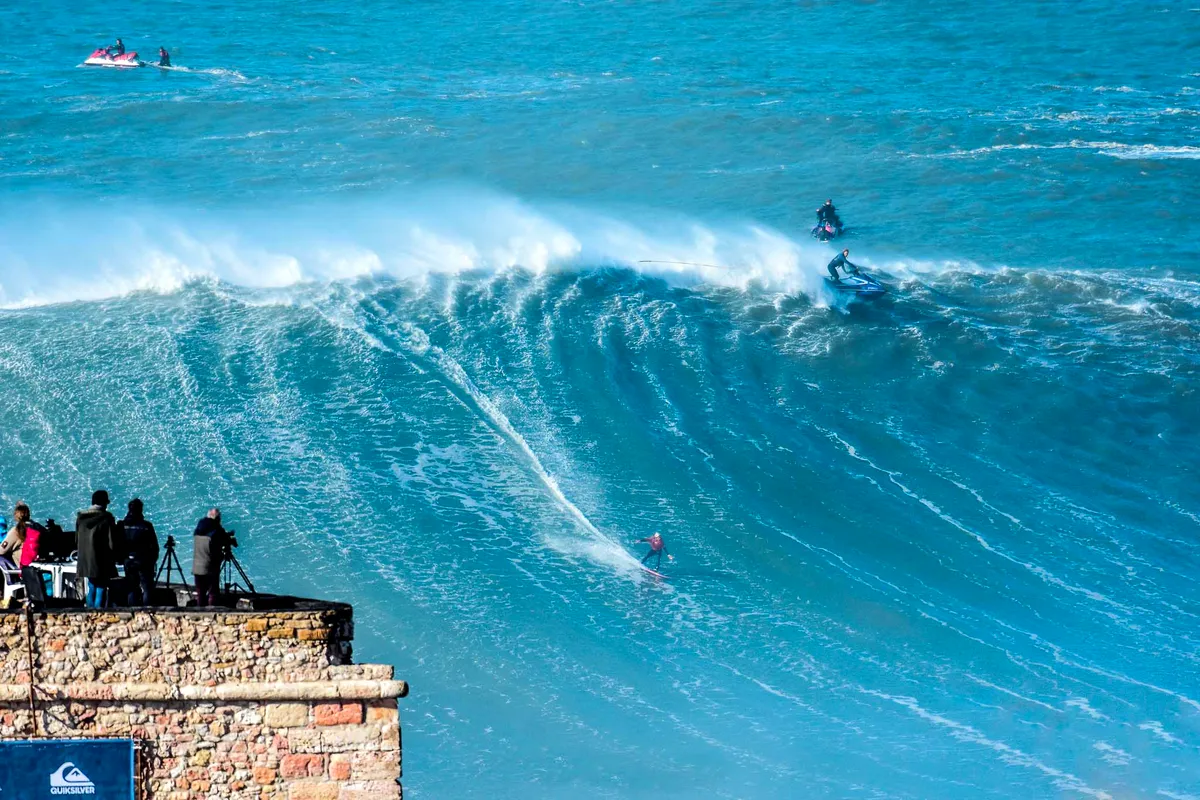 Photo: Luis Ascenso from Lisbon, Portugal · CC BY 2.0 · Wikimedia Commons
- Level
- Expert
- Direction and bottom
- Both · Mixed
- Best swell
- NW groundswell, long period
- Best wind
- Light E–SE offshore
- Best tide
- Depends on the swell; ask the big-wave teams
- Best months
- Oct, Nov, Dec, Jan, Feb
- Size
- Ordinary days are heavy beach-break surf; big days are 20 m faces and above
- Hazards
- Giant whitewater, Strong currents, Rocks and headland, Beach restrictions, Cold water
How a canyon makes a giant
A deep submarine canyon runs towards the coast at Nazaré, and swells moving along it are not slowed by shallow water in the way that they would be on a normal beach. Different parts of the swell travel at different speeds, so when they reach the headland they can combine into a much larger peak. The result is a wave that rises out of deep water close to the shore, which also explains why tow-in teams can work so near the cliff.
The wave records on Wikipedia give a sense of the scale. A figure of 23.8 metres (78 feet) was given for Garrett McNamara in November 2011, and Rodrigo Koxa of Brazil was credited with 24.4 metres on 8 November 2017. Sebastian Steudtner of Germany was credited with 26.2 metres on 29 October 2020, and a wave of 28.5 metres in February 2024 was described as not yet officially recognised. For women, Maya Gabeira of Brazil has been credited with 22.4 metres in February 2020.
The season for watching
The giant days come in the cold half of the year, when large north-west groundswells cross the North Atlantic. The Tudor Nazaré Tow Surfing Challenge, part of the WSL Big Wave Surfing series, is held during the winter months, and Wikipedia says waves there often reach 40 to 50 feet. Even in a calm spell, the beach can serve up powerful breaking waves, so the sea at Praia do Norte should be respected throughout the year.
The big days are announced by forecasts days in advance. Tow teams, rescue skis and photographers gather in the same place at the same time, and the harbour town fills with visitors. If your only aim is to see a very big wave, the winter forecast and the local surf reports will tell you more than a calendar.
Who must not surf it
Praia do Norte is not suitable for recreational surfers, including strong ones. Giant waves here are ridden by small groups of experienced big-wave surfers working with tow drivers, jet skis, safety boats and medical support. Anyone without that experience and support should stay on shore. The whitewater is heavy enough to hold people under for a long time, currents are strong, and the headland offers no easy exit for a swimmer.
Swimming is a bad idea on the beach itself on any day with a significant swell. Authorities may restrict access to the sand or the water on dangerous days, and you should follow warning signs and any instructions from the lifeguards or the local police. If you want to surf near Nazaré, ask a local school about the beach breaks away from the headland and pick a smaller day.
Where to watch from
The classic viewpoint is the Fort of São Miguel Arcanjo beside the lighthouse. Wikipedia names it as a place to see the beach and the tow-in action, and it gives you a high angle onto the waves as they stand up in front of the cliff. On a large day the fort and its approach can be very busy, so arrive early and take warm clothing, because the wind is often strong and cold.
From the fort you can also see the line of rescue skis waiting outside, which helps explain how the sport works. Keep a safe distance from the cliff edge, particularly in wet or windy weather, and do not stand on sections of the headland that are closed. If the fort is full, the town beach and the cliff-top footpaths give different views, though from further away.
Getting to Nazaré
Nazaré is on Portugal's Silver Coast, north of Lisbon, and is usually reached by hire car, coach or a combination of train and bus. The fishing quarter, the funicular and the seafront give the town its character in any weather, and there is plenty of accommodation, though it fills quickly when a big swell is forecast. Confirm bus times and parking before you set out, because local conditions during a large swell change from year to year.
The destination guide for Nazaré covers the town, its beaches and the summer surf scene, and this page deals only with the giant wave at the north end.
The ocean off Nazaré, by month
| J | F | M | A | M | J | J | A | S | O | N | D | |
|---|---|---|---|---|---|---|---|---|---|---|---|---|
| Swell, m | 2.3 | 2.5 | 2.5 | 1.7 | 1.6 | 1.3 | 1.2 | 1.3 | 1.4 | 1.7 | 1.8 | 2.0 |
| Period, s | 13 | 14 | 13 | 11 | 10 | 10 | 9 | 9 | 10 | 12 | 12 | 13 |
| Water, °C | 14 | 14 | 14 | 15 | 16 | 17 | 18 | 18 | 18 | 17 | 17 | 15 |
Open-ocean ERA5 medians, not wave size at the break. Sources.
Questions about Praia do Norte (Nazaré)
Can I surf at Praia do Norte?
Not unless you are an experienced big-wave surfer with proper safety support. The waves can be enormous, and rescue is difficult. Most visitors should watch from the fort and surf at smaller beaches nearby.
When are the biggest waves?
Mainly from autumn through winter, during large north-west groundswells. The record waves listed on Wikipedia were ridden between October and February. Check surf and weather forecasts for specific dates.
Why are the waves so big at Nazaré?
An underwater canyon allows swell to approach the coast without losing energy, and it helps different parts of the swell combine into a larger peak. This is the explanation given on Wikipedia.
Where is the best place to watch?
The Fort of São Miguel Arcanjo beside the lighthouse is the best-known viewpoint. It gets crowded on big days, so go early and stay behind barriers.
Check a live forecast and local advice before paddling out. Heavy waves injure and kill experienced surfers.