The breaks
Recognised, publicly known surf spots around Madeira. Suitability depends on the day's swell, wind and tide, so treat the level as a guide, not a guarantee.
| Break | Type | Best for | Notes |
|---|---|---|---|
| Jardim do Mar | Right-hand boulder point | Advanced | Madeira's signature wave, best on a westerly swell with north-easterly offshore wind. Awkward rock entry and a tight line-up; not a place for learners. |
| Paul do Mar | Right-hand reef | Intermediate–Advanced | A short distance from Jardim do Mar and generally less busy. No lifeguards, shallow rock, and a swell that can build quickly in autumn and winter. |
| Ponta Pequena | Reef point | Intermediate–Advanced | Between Jardim do Mar and Paul do Mar. Works on some swells when its neighbours are less favourable, but access and tide need checking on the day. |
| Ponta do Sol | Exposed reef | Advanced | Fairly exposed and selective: it only works when swell, tide and wind combine. Less reliable than the south-west points, so treat it as a bonus. |
Madeira surf climate, measured
Ten years of ocean model data for the open water off this coast: what the swell usually looks like before it reaches the beach. Shelter, sandbars and reefs change what you actually surf, so read this next to the month notes below.
| Month | Swell | Period | From | Wind | Water | Wetsuit | Days over 2.5 m |
|---|---|---|---|---|---|---|---|
| Jan | 2.3 m | 13 s | NW | 16 km/h NE | 18°C | 3/2 mm full suit | 35% |
| Feb | 2.5 m | 13 s | N | 18 km/h NE | 17°C | 3/2 mm full suit | 50% |
| Mar | 2.5 m | 13 s | N | 17 km/h N | 17°C | 3/2 mm full suit | 50% |
| Apr | 2.0 m | 12 s | NW | 16 km/h NE | 17°C | 3/2 mm full suit | 25% |
| May | 2.0 m | 10 s | N | 20 km/h N | 18°C | 3/2 mm full suit | 8% |
| Jun | 1.4 m | 9 s | N | 16 km/h N | 20°C | 2 mm shorty or spring suit | 0% |
| Jul | 1.4 m | 8 s | N | 16 km/h NE | 21°C | 2 mm shorty or spring suit | 0% |
| Aug | 1.4 m | 8 s | N | 15 km/h NE | 22°C | Rash vest or 1 mm top | 0% |
| Sep | 1.6 m | 10 s | N | 12 km/h N | 23°C | Rash vest or 1 mm top | 5% |
| Oct | 1.8 m | 12 s | N | 13 km/h N | 22°C | Rash vest or 1 mm top | 18% |
| Nov | 2.0 m | 11 s | NW | 15 km/h NE | 21°C | 2 mm shorty or spring suit | 25% |
| Dec | 2.4 m | 12 s | NW | 16 km/h S | 19°C | 2 mm shorty or spring suit | 45% |
Median values from ERA5 at a sea point near Madeira (32.75°N, 17.25°W), sampled 4 days a month at 12:00 UTC, 2015-2024. Highlighted months are our suggested planning window. Not a forecast or a safety assessment. How we use this data.
Book a surf trip to Madeira
Everything we can link you to for this trip, grouped by what you need. Before you pay a camp or school, read who holds your money, and check that your insurance covers surfing.
Where to stay
Search near the breaks. Filter for surf hostels, apartments or hotels once you can see the map.
Surf lessons and activities
Listings change by season, so check what the operator includes and who coaches.
Flights
Add your dates and check the board fee on every leg before you pay.
Car hire
Ask about roof racks and whether the insurance covers boards on the roof.
Airport transfer
Tell the driver you have a board and its length when you book.
Mobile data
Download a forecast app and offline maps before you land.
Flight delay claims
If a delay eats your first surf day, check whether you can claim.
Luggage storage
Useful between check-out and a late flight. Check the size limit before dropping a board.
Links marked as partner links may earn us commission at no cost to you; the rest earn us nothing. We have not checked live availability or price, and the seller's terms apply. How we handle this.
Cheapest months to fly to Madeira
Lowest return fare to FNC that Aviasales users found recently, in US dollars. Treat these as a guide to which months are cheaper, not as prices you can book today.
| From | Nov 26 | Dec 26 | Jan 27 | Feb 27 | Mar 27 | May 27 |
|---|---|---|---|---|---|---|
| London | $80 | $168 | $109 | – | – | – |
| Frankfurt | $210 | $139 | $161 | $230 | $303 | $317 |
Prices seen by 1 November 2026. Travelpayouts Data API. Board fees are extra on most airlines: see our surfboard baggage guide.
Why Madeira's waves are hard to find
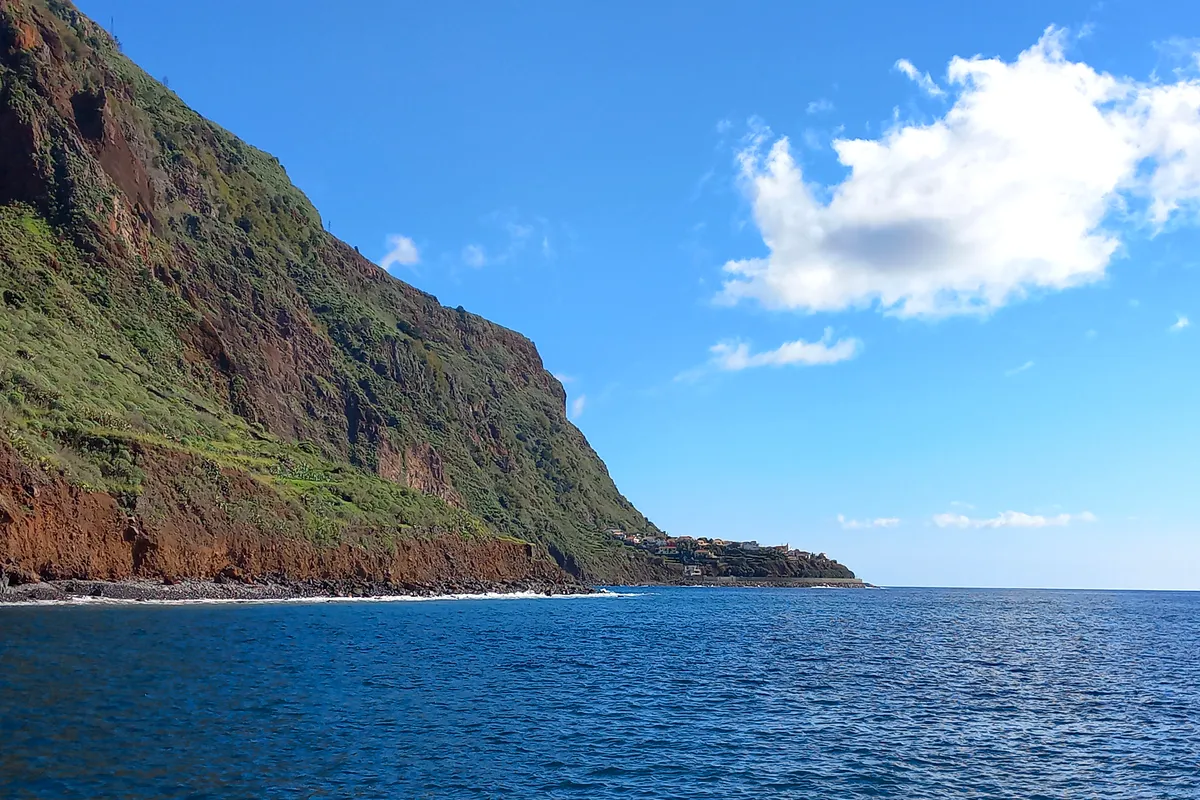
Madeira is a shield volcano roughly 57 kilometres long and 22 at its widest, rising to Pico Ruivo at 1,862 metres. That geography explains the surf. Steep cliffs drop straight into deep water, so there are few sandy bays where waves can spread out and break gently. The island's best waves are concentrated along the south-west coast, where boulder and rock platforms bend winter swell into rideable points.
That makes Madeira a very different trip from mainland Portugal. There is no long beach lined with surf schools, and a short drive does not bring you to another half-dozen options. Instead, a few well-known waves work in the right combination of swell and wind, and the rest of the island offers dramatic scenery, hiking and levada walks. Treat it as a surf-and-explore destination, and keep expectations realistic about days when nothing is working.
Jardim do Mar, Paul do Mar and the south-west points
Jardim do Mar is the island's best-known wave: a right-hander breaking over boulders below a small village. Guides describe it as working best when a westerly swell meets offshore wind from the north-east, and as most productive between October and March. It is not a place to learn. Entry and exit over rounded rocks can be awkward, and the line-up is small enough that etiquette matters.
A short distance along, Paul do Mar is a reef break with a reputation for being less crowded and, according to some guides, more consistent. Ponta Pequena sits between the two and is described as an intermediate to advanced wave. There are no lifeguards at these breaks, and help is not close. Surf with a partner, check your fitness and be honest about how you handle rocky ground.
Ponta do Sol, and the exposed alternatives
Ponta do Sol, further east along the south coast, is a fairly exposed reef break that only works in the right conditions. It is more of a bonus than a reason to base a trip, and depends on the swell direction and size. Forecast sites suggest that winter, and February in particular, is when it comes alive, but any such pattern is a guide only.
On the island's north coast the swell is larger and more raw, with few access points, and local knowledge matters. Most visitors stay on the south-west side, where the waves are more organised and the roads are better, and look for other forms of water sport on days with a poor forecast.
A wetsuit for a subtropical island
One surf guide gives year-round water temperatures between 19 and 24 degrees Celsius, which is warmer than mainland Portugal. Even so, treat that as a rough range rather than a promise. In midwinter, with wind and rain, a 3/2 is a minimum and many surfers prefer a 4/3 for early starts and long sessions.
Summer needs little more than a shorty or a thin full suit, but summer is also the season when the swell is typically too small for the south-west points. Pack for a wet suit that you can get on and off quickly, because the climate is subtropical with winter rain and the weather can change fast. Wear reef boots if you intend to enter over boulders, to protect against sharp rock and sea urchins.
Funchal, the west coast and where to base yourself
Funchal, the island's capital and largest city, has around 105,000 residents and the airport transfer reaches it quickly. It is a good base if you want restaurants, a harbour and a wide choice of accommodation, but it is a drive from the south-west surf. Plan on a significant trip each way, and check road conditions and tunnel routes before you set out.
Basing yourself in Calheta, Ponta do Sol or a village near Jardim do Mar and Paul do Mar puts you closer to the waves and allows quick dawn checks. These bases are quieter in the evenings, so decide whether surf or atmosphere matters more. A rental car is almost essential, both for flexibility and because bus services are limited for early starts.
Hiking and levadas on flat days
Madeira's laurel forests on the northern slopes are a UNESCO World Heritage Site, and the island is crossed by levadas, the narrow irrigation channels with walking paths beside them. On a flat or onshore day, a levada walk or a drive up towards the central peaks is a better use of time than staring at an empty line-up.
The climate is subtropical, with dry Mediterranean-style summers and wetter winters, and rainfall varies greatly across the island, from relatively dry coasts to areas that receive up to 2,800 millimetres a year. Bring a waterproof, and do not assume that the weather where you surf matches the weather at altitude.
Risk, respect and local etiquette
The surf community around the south-west points is small, and many surfers know each other. Arrive quietly, wait your turn and do not paddle past the person who is next in line. A crowded peak at Jardim do Mar is unforgiving for anyone who cannot position themselves properly.
Be clear about your own limits. Entry points over boulders, shallow water at low tide and heavy waves on larger swells can all injure a surfer who is out of their depth. Surf with a buddy, tell someone where you are going and keep the weather forecast in view throughout the day.
Madeira surf season month by month
A broad planning picture, not a forecast. Swell, wind and water temperature vary from year to year.
| January | Peak winter swell, with the south-west points at their most powerful. Rain is common and the water is at its coolest, so a 4/3 is sensible. |
|---|---|
| February | Often the biggest month for Ponta do Sol according to forecast sites. Expect strong swells, rough weather and few other visitors. |
| March | Swell remains regular while days lengthen. Gradually calmer weather, and a good month for combining surf with levada hikes. |
| April | The season tails off. Waves become smaller and less frequent, and the island turns green and flowery, so it suits a mixed trip. |
| May | Mostly small. Some days can still deliver at the right points, but plan around walking and exploring more than surfing. |
| June | Usually flat on the south-west points. Warm, sunny weather and long days suit the island's non-surf attractions. |
| July | Summer lull. Surf trips are unlikely to pay off, though a swell on the right track occasionally gives a fun session. |
| August | Peak holiday season on the island with minimal swell. Book transport early and keep expectations low for surf. |
| September | Early autumn swells start to appear and the sea is at its warmest. A hopeful, uncrowded month for patient surfers. |
| October | The season begins in earnest, with regular swell and warm water. Jardim do Mar and Paul do Mar start to work with the right wind. |
| November | Consistent swell, increasingly strong, and more rain. Good for experienced surfers who can handle rocky entries. |
| December | Powerful swell and short days. Quiet in the water, but bigger days make the boulder entries and exits risky. |
Is Madeira a place to learn?
Honestly, not really. The best-known waves break over boulders and rock, and the main line-ups are small and demanding. There is surf tuition on the island, but the kind of gentle sandy beach used by learners elsewhere in Portugal is not Madeira's strength.
If you are a beginner, take lessons on mainland Portugal or in the Canaries first, and come to Madeira once you can read a line-up, paddle out confidently and control your board in white water. If you do book a lesson here, ask where it takes place, how many students are in the group and what the instructor will do when the swell is too big.
Intermediate surfers who want to step up to point-break waves can benefit from local guidance, but should choose small days and expect to watch more than they surf.
Comparing options across the country? Read our guide to surfing in Portugal.
Seasonal notes on this page describe typical patterns, not the conditions on a given day. Use the local forecast, lifeguard advice and a qualified instructor for water-safety decisions, and get a written breakdown of what any surf package includes before paying.
Madeira surf trip questions
When is the best time to surf in Madeira?
Autumn and winter, from October to March, when Atlantic swells reach the south-west coast. Summer is typically small and best used for hiking and sightseeing.
Is Madeira good for beginners?
Generally no. The main waves break over boulders and rock with small line-ups. Learners are better served on mainland Portugal or elsewhere, then visiting once they have experience.
Which are the best surf spots in Madeira?
Jardim do Mar is the most famous, followed by Paul do Mar, Ponta Pequena and Ponta do Sol. All are on the south-west or south coast and suit experienced surfers.
How warm is the water in Madeira?
One guide quotes 19 to 24 degrees Celsius through the year. In winter, many surfers still wear a 4/3 because of wind and rain, and boots are useful for rocky entries.
Do I need a car in Madeira?
Almost certainly. The surf spots are along the south-west coast and bus times are limited, so a rental car gives flexibility. Check tunnel and road conditions as the weather changes.
Sources & editorial notes
Destination context checked against the sources below. Base-selection and itinerary suggestions are Book & Surf editorial recommendations. Seasonal windows are broad planning suggestions, not measured forecasts or guarantees.
- Wikipedia: Surfing in Madeira ↗
- The Surf Atlas: Jardim do Mar ↗
- Surf-Forecast: Jardim do Mar ↗
- Wikipedia: Madeira ↗
We do not claim to have personally surfed every break. Read our editorial standards.