Jaws (Peʻahi).
Peʻahi, better known as Jaws, is a big-wave break on the north shore of Maui, a few hundred feet off the cliffs east of Pāʻia. Wikipedia says waves can exceed 60 feet from December to March and that an underwater ridge generates the size. The name Peʻahi means wave in Hawaiian, and Jaws was a nickname coined in 1975 after the film. The break matters well beyond Maui, because it is one of the places where modern tow-in surfing was developed, and it remains a spectator experience for the few days each winter when it breaks.
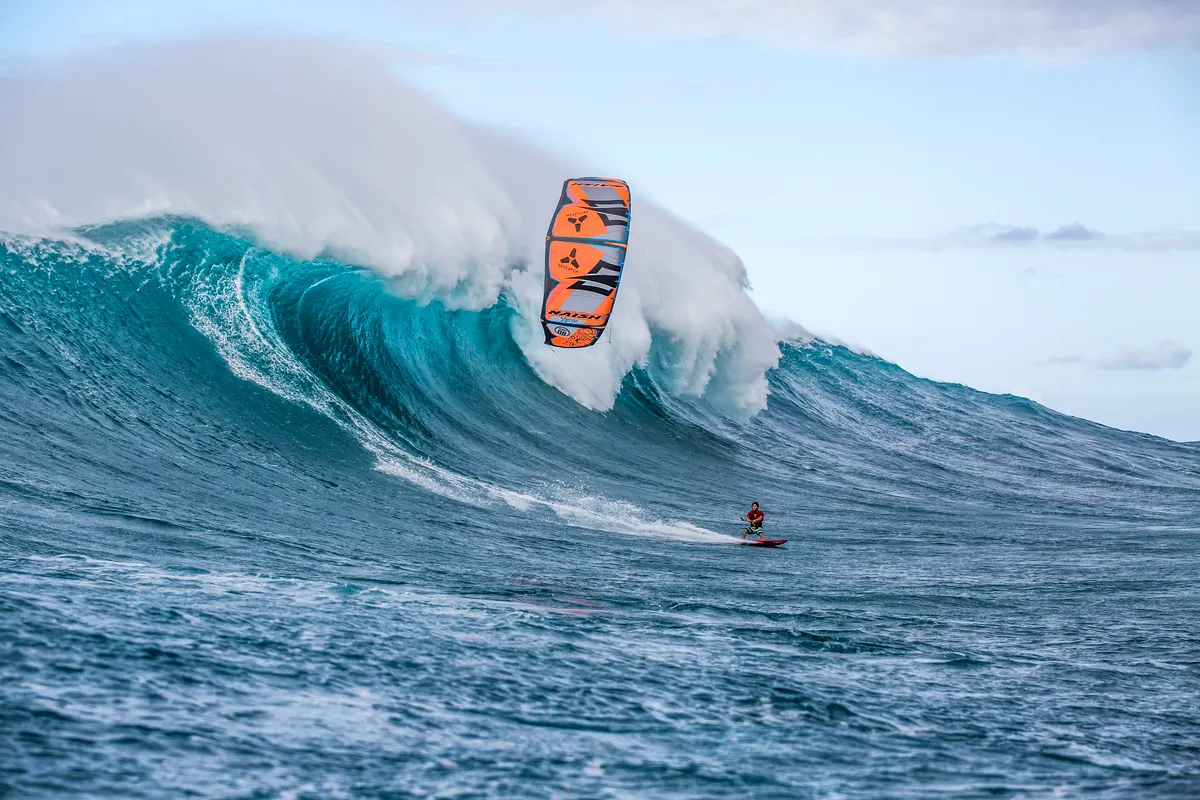 Photo: Pierre Bouras · CC BY-SA 4.0 · Wikimedia Commons
- Level
- Expert
- Direction and bottom
- Right · Reef
- Best swell
- NNE to NW, large and long-period
- Best wind
- SSW offshore
- Best tide
- Not a major factor
- Best months
- Dec, Jan, Feb, Mar
- Size
- Rideable from about 20 ft; can exceed 60 ft on the biggest days
- Hazards
- Giant waves, Remote location, Strong currents, Rocky cliff coast, Tow-in traffic
How it became a tow-in laboratory
In the 1980s windsurfers Mark Pedersen, Dave Kalama and Brett Lickle surfed the break from Hoʻokipa, according to Wikipedia. Laird Hamilton and Dave Kalama became known for tow-in surfing, a method they co-invented with Darrick Doerner and Buzzy Kerbox, using personal watercraft to tow surfers into waves too fast to paddle. Teams usually launch from the Māliko Bay boat ramp to avoid a steep climb and rocky water.
Paddle-in surfing came later. Chris Bertish was the first to paddle into giant surf at Jaws in 2001, and Brazilian surfers began without jet-ski support in 2006. Today both styles appear. Contests such as Red Bull Jaws invited top big-wave surfers into a waiting period in the winter of 2012 and 2013, and World Cup of Tow-in Surfing events have been held when conditions allowed.
Season, size and wind
Surf-Forecast gives the best swell as north-north-east and the best wind as south-south-west offshore. Groundswells are more common than windswells, and the page says tide does not affect the surf. Winter is best, especially December, but the figures show only about 14 percent of that month as clean, 47 percent blown out and 39 percent too small. That fits the nature of the break: it needs a big, well-organised swell and light wind, and the right combination is rare.
The page rates the break five out of five from a small number of votes and gives a difficulty rating of 4.2 out of 5. Water temperature is about 27 degrees Celsius, so wetsuits are chosen for protection against impact rather than warmth. The forecast tool is useful for tracking swells in advance, but timing is difficult, and most days of the year are small.
Who should not surf Jaws
Jaws is only for highly experienced big-wave surfers who work in teams with rescue skis, safety divers and medical support. Wikipedia says even experienced surfers can be seriously injured, and the remote location means rescues often need expensive helicopter evacuations. The wave breaks several hundred feet from the cliff, there is no beach, and the rocky coast offers no easy exit.
If you have not trained for big-wave surfing, do not get anywhere near the water. Do not swim in the bay at the bottom of the cliff, do not attempt to walk down the cliff and do not take small craft out to look. Surf-Forecast lists rips and rocks as the main hazards. The spot is usually rarely crowded, but on big days the water is full of skilled people operating under pressure.
Getting there and watching safely
The break is roughly three miles east of Pāʻia and seaward of the Hana Highway. Wikipedia names the Peʻahi Overlook, at the end of Hahana Road between mile markers 13 and 14, as the best viewing point. Hahana Road is mostly unpaved, four-wheel drive is recommended and access is hard when wet. Otherwise it is about a 1.5 mile walk. Kahului airport is about 17 kilometres away on Surf-Forecast's figure.
Watching is done from clifftops 100 to 150 feet above the sea, so stay behind any barriers and keep children and pets under control. The road passes private land and a farm, so follow signs, avoid blocking gates and park only where allowed. Crowds grew after publicity in 2002 and overcrowding on the road became an issue by 2004, so be considerate to local residents.
Planning around the swell
Because Jaws works only on a handful of days, most visitors combine it with other Maui activities. Nearby breaks on Surf-Forecast include Pavillions, H-Reef and Hookipa, which have a wide range of difficulty. The Maui destination guide covers the island, beginners' beaches and winter swells.
Etiquette for spectators
Peʻahi draws crowds on big days, and the cliff-top experience works best when visitors behave considerately. Park only where permitted, avoid blocking farm gates or neighbours' driveways, and keep noise down. Do not climb fences or walk onto private land to get a better view. Bring binoculars or a long lens, because the wave breaks some distance from the cliff, and carry water, a hat and a windproof layer. If you are driving, check the state of the road and the weather before setting out, and be prepared to walk the final stretch. Watching quietly from the overlook is the best way to appreciate the scale of the wave.
The ocean off Maui, by month
| J | F | M | A | M | J | J | A | S | O | N | D | |
|---|---|---|---|---|---|---|---|---|---|---|---|---|
| Swell, m | 2.3 | 2.3 | 2.2 | 1.8 | 1.7 | 1.5 | 1.6 | 1.5 | 1.5 | 1.8 | 2.1 | 2.4 |
| Period, s | 14 | 12 | 11 | 10 | 9 | 8 | 8 | 8 | 8 | 11 | 11 | 14 |
| Water, °C | 25 | 24 | 24 | 24 | 25 | 26 | 26 | 27 | 27 | 27 | 26 | 25 |
Open-ocean ERA5 medians, not wave size at the break. Sources.
Questions about Jaws (Peʻahi)
What does Peʻahi mean?
Wikipedia says it means wave in Hawaiian and was an ancient land division. The nickname Jaws was coined in 1975 by surfers comparing the wave to the film.
How big does Jaws get?
Wikipedia says waves can exceed 60 feet from December to March. Most days are far smaller.
Can I watch from the cliff?
Yes, from the Peʻahi Overlook at the end of Hahana Road. Four-wheel drive is recommended when the road is wet, otherwise it is about a 1.5 mile walk.
Is Jaws suitable for visiting surfers?
Only for experienced big-wave surfers with safety teams. Others should watch from the cliff.
Check a live forecast and local advice before paddling out. Heavy waves injure and kill experienced surfers.