Steamer Lane.
Steamer Lane is the cluster of right-hand reef breaks off the West Cliff headland in Santa Cruz, a short walk from downtown. Wikipedia describes four parts, Indicators, Middle Peak, The Slot and The Point, with Third Reef beyond as an expert zone, and notes the easy access and good vantage point. A lighthouse on the cliff holds the Santa Cruz Surfing Museum, staffed by volunteers from the Santa Cruz Surfing Club. The Lane is among the most-watched waves in California, and it is a more demanding place than it looks from the railing.
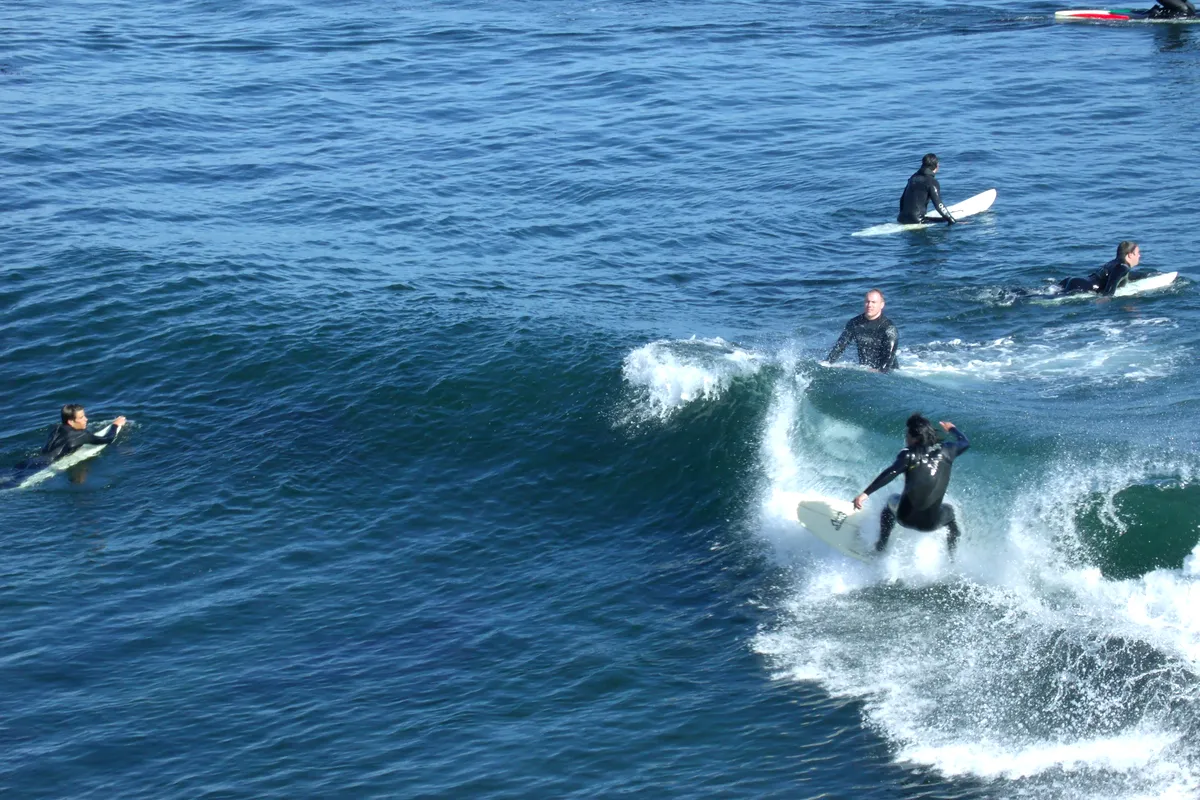 Photo: Noah_Loverbear · CC BY-SA 3.0 · Wikimedia Commons
- Level
- Intermediate
- Direction and bottom
- Right · Reef
- Best swell
- SW to NW groundswell
- Best wind
- NE offshore
- Best tide
- Mid tide on the rise
- Best months
- Apr, May, Jun, Jul, Aug, Sep, Oct
- Size
- Knee-high to overhead; much bigger in winter storms
- Hazards
- Rocks in the lineup, Crowds, Cold water, Cliff access, Heavy winter surf
The four zones
Indicators is the inside section, closest to the shore, and is typically the most approachable. Middle Peak and The Slot are the central takeoff zones, where the wave steepens and lines up. The Point is the outermost of the main peaks, and Surf-Forecast describes it as an exposed reef break working to the right with very high consistency. Third Reef lies beyond and is reserved for larger swells and experts, according to Wikipedia.
Rides can link from outer to inner sections on bigger days, giving a long wall that fans out along the cliffs. The break works on a variety of swell directions, which helps explain why the Lane has been a training ground for generations of surfers. The cliff face above the water provides one of the best viewpoints of any wave in California.
Swell, wind and tide
Surf-Forecast lists the best swell as south-west groundswell, the best wind as north-east, with north-west winds partly sheltered, and the best tide as mid tide on the rise. January appears as the strongest month on its statistics, but the same figures show about 70 percent of that month as too small for most surfers, because the page is measuring rideable days for general use rather than the strength of the big swells. In practice, Steamer Lane has good surf in summer and autumn when south and south-west swells arrive.
The water temperature on the page is about 18 degrees Celsius, so a summer wetsuit is suggested, but a thicker suit is normal for much of the year. Fog is common in summer, and the wind picks up in the afternoon, so mornings are often the best period.
Fog and a cool onshore breeze are common on this stretch of coast, even in summer, so the best sessions are often early. A forecast that looks promising can be spoiled by the afternoon wind, and the cliff-top view will tell you more than any chart.
Who should not surf it
Steamer Lane is not a beginner wave. The lineup is crowded, with surf school groups, locals and visitors competing for waves, and Surf-Forecast warns of rocks in the lineup. Wikipedia also notes tension between local surfers and surf kayakers who share the waves. Newcomers who do not understand right of way, or who cannot paddle quickly to catch a moving wave, are likely to cause problems.
Intermediates can enjoy the inside sections on smaller days, but winter storms bring heavy surf, strong currents and large sets that can overwhelm even good surfers. If you are unsure of your ability, watch from the cliff, then paddle out at Indicators on a gentle day. Learners are better off at the sheltered bays nearby, such as Cowells, which Surf-Forecast lists at about a kilometre from the Lane.
Getting there and watching
Steamer Lane is at the end of West Cliff Drive, close to the lighthouse and the museum. San Jose airport is about 47 kilometres away on Surf-Forecast's figure, and Moffett Field is about 52 kilometres. Santa Cruz is reachable by road from the San Francisco Bay Area over the mountains on Highway 17 or along the coast. Parking along West Cliff Drive fills quickly on weekends and in summer.
The cliff-top railings and the paved path let you watch safely, and many people do. Take binoculars if you want to follow individual rides. Observe signs about cliff erosion and stay on the pathways. Respect the museum and any docents who staff the area. The site lies within the Monterey Bay National Marine Sanctuary, so take litter home and keep dogs and children under control.
History in brief
Claude Horan named the spot in the late 1930s, according to Wikipedia, as a student at San Jose State. He and Wes Hammond jokingly proposed hiring steamships to cruise back and forth to create waves. Jack O'Neill helped develop the modern wetsuit and surf leash from a nearby surf shop. Surf-Forecast lists Cowells Cove and Mitchell's Cove close by. The Santa Cruz destination guide describes the wider area.
The ocean off Santa Cruz, by month
| J | F | M | A | M | J | J | A | S | O | N | D | |
|---|---|---|---|---|---|---|---|---|---|---|---|---|
| Swell, m | 2.3 | 1.9 | 2.0 | 1.8 | 1.7 | 1.6 | 1.4 | 1.3 | 1.4 | 1.6 | 1.8 | 2.1 |
| Period, s | 13 | 13 | 12 | 13 | 11 | 10 | 9 | 10 | 11 | 13 | 13 | 13 |
| Water, °C | 13 | 13 | 13 | 13 | 12 | 13 | 14 | 15 | 15 | 15 | 14 | 13 |
Open-ocean ERA5 medians, not wave size at the break. Sources.
Questions about Steamer Lane
Is Steamer Lane a left or a right?
A right. Surf-Forecast describes The Point as a reef break working to the right, and the other peaks also break right along the cliffs.
Can beginners surf Steamer Lane?
Not usually. The lineup is crowded and rocky. Beginners are better at Cowells or another sheltered bay with a school.
What is the best tide?
Mid tide on the rise, according to Surf-Forecast. Check local tide tables and the swell forecast.
Where can I watch?
From the cliffs along West Cliff Drive near the lighthouse. The Santa Cruz Surfing Museum is in the lighthouse.
Which part of Steamer Lane suits intermediates?
Indicators, the inside section, is usually the most approachable, particularly on smaller days. Middle Peak and The Slot are more competitive, and The Point and Third Reef are for strong surfers. Watch from the cliff first, and pick the section that matches your confidence.
Check a live forecast and local advice before paddling out. Heavy waves injure and kill experienced surfers.