Waimea Bay.
Waimea Bay is a crescent-shaped bay at the mouth of the Waimea River on Oahu's North Shore. In summer it is calm enough for swimming and cliff jumping, and in winter large swells turn it into one of the world's best-known big-wave surfing locations. Wikipedia describes it as widely known for its big wave surfing, and notes that Captain Charles Clerke's ship stopped briefly here on 27 February 1779. The bay has two faces, and it is vital to know which one you are looking at before you get into the water.
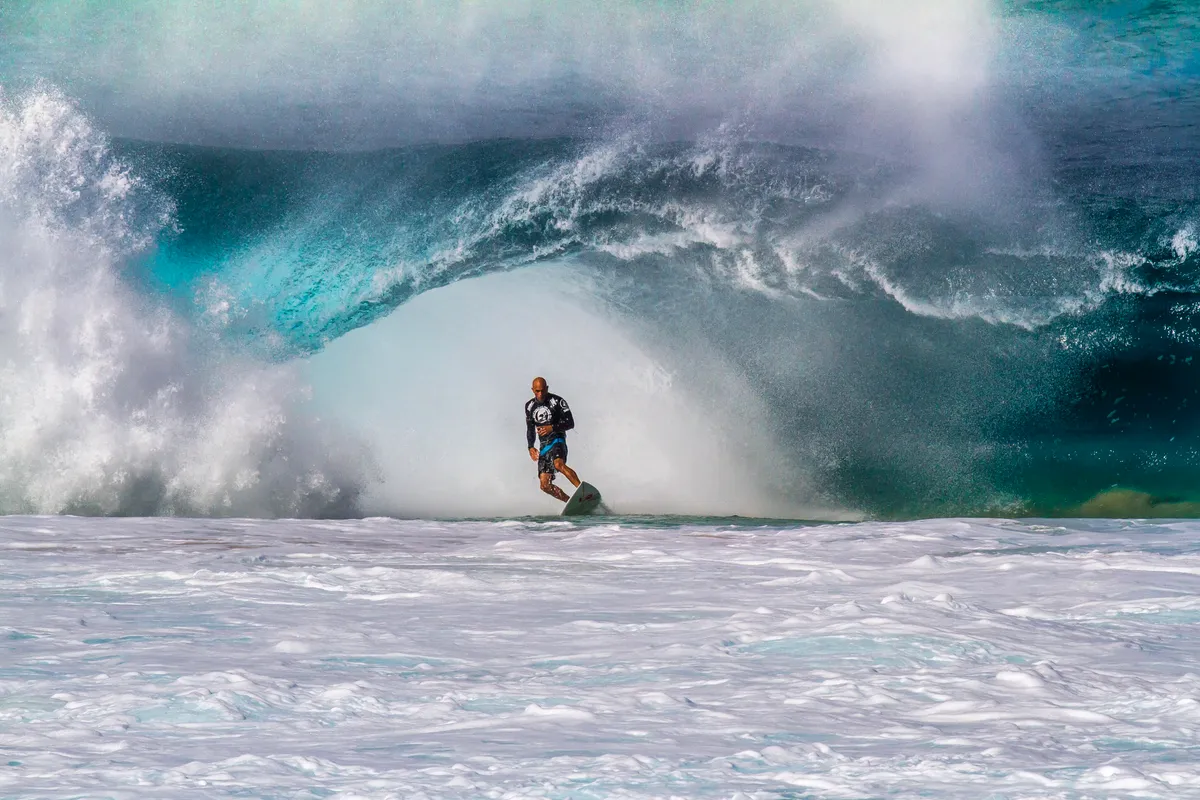 Photo: Fosterand sons · CC BY-SA 4.0 · Wikimedia Commons
- Level
- Expert
- Direction and bottom
- Right · Reef
- Best swell
- NW, large and long-period
- Best wind
- ESE offshore
- Best tide
- Check with local lifeguards
- Best months
- Dec, Jan, Feb
- Size
- Flat or a shorebreak for most of the year; becomes rideable on very large winter swells
- Hazards
- Giant surf and hold-downs, Powerful shorebreak, Rips and currents, Crowds of expert surfers, Local etiquette
A bay with two seasons
Surf-Forecast lists Waimea Bay, also called Pinballs, as an exposed reef break that breaks to the right and receives distant groundswells. It tells us that winter is best, especially January, with clean waves about 52 percent of the time, blown out about 29 percent, and too small about 19 percent. Summer is mostly flat.
In practice the wave only reaches its famous size on a large north-west swell. Smaller swells close out in the bay and produce a powerful shorebreak that is a hazard for swimmers and bodyboarders. When the swell is big enough, a right-hand wave stands up on the reef outside the point and offers long, fast rides to surfers who can handle the size. The page rates the spot five out of ten and calls its reliability consistent.
Conditions and safety
The best wind is east-south-east, which is offshore, and the sea temperature is around 26 degrees Celsius according to Surf-Forecast. The page lists hazards as rips and locals who can be unwelcoming, and the lineup is described as sometimes crowded. Those two warnings should be taken seriously. When Waimea is working, the surfers in the water are among the most experienced in the world, and the consequences of a mistake are severe.
Even on days when the bay looks calm from the road, the shorebreak can be heavy and the rip along the rocks can be strong. Lifeguards post warning flags and may close the beach. Obey their instructions, particularly if you are not familiar with the North Shore. If a lifeguard says do not enter the water, do not argue.
Who should not surf Waimea
Do not surf Waimea Bay on a big day unless you are an experienced big-wave surfer with the right equipment, physical preparation and local knowledge. The paddle-out is long and exposed, the waves are large and powerful, and rescue is difficult. Hold-downs can be long enough to cause serious harm, and the surf can change quickly when a new set arrives.
Most visitors should simply watch. The bay has a wide sandy beach where spectators can see the lines from a safe distance. If you want to get in the water, wait for a calm summer day, stay close to the shore and swim with caution. Never turn your back on the sea on a big winter day, because waves can run far up the sand and sweep people into the water.
Access and watching
Waimea Bay lies along Kamehameha Highway in Haleiwa district. Wikipedia places the bay on the north-west side of the highway at the entrance point. Surf-Forecast lists Dillingham Airport at about 16 kilometres and Kaneohe Bay at about 38 kilometres, but most visitors fly into Honolulu and drive north. Parking is limited, and on big-swell days cars line the road for a long distance.
The beach and the rock at the north end provide good views. Pu'u o Mahuka Heiau State Monument, a historic Native Hawaiian site above the bay, offers a wide view of the bay and the Waianae Range, according to Wikipedia. Show respect for the site and follow any posted rules. Arrive early on big days to get a parking space, and allow time for traffic.
Context on the North Shore
Banzai Pipeline and Backdoor, Ehukai, Log Cabins and Off the Wall are all within about a kilometre of Pipeline on Surf-Forecast's list, and Waimea is a short drive to the west. The North Shore guide covers how these breaks fit together and where beginners can find gentler waves.
A note on swimming and the shore
Waimea Bay is popular for swimming, snorkelling and rock jumping in summer, and the contrast with winter can catch visitors out. In winter, a large set can surge across the sand and drag people into the shorebreak. Stay well back from the water's edge, keep children close and obey lifeguard instructions. If you want to surf, ask the lifeguards what sizes are manageable, and consider other North Shore beaches when Waimea is big. Parking is limited, and cars may be ticketed or towed, so read signs carefully. The valley above the bay has cultural significance, so treat the area respectfully.
The ocean off North Shore, Oahu, by month
| J | F | M | A | M | J | J | A | S | O | N | D | |
|---|---|---|---|---|---|---|---|---|---|---|---|---|
| Swell, m | 2.6 | 2.7 | 2.4 | 2.1 | 1.9 | 1.6 | 1.7 | 1.7 | 1.7 | 2.1 | 2.4 | 2.7 |
| Period, s | 14 | 12 | 11 | 10 | 9 | 8 | 8 | 8 | 9 | 11 | 11 | 13 |
| Water, °C | 25 | 24 | 24 | 24 | 25 | 26 | 26 | 27 | 27 | 27 | 26 | 25 |
Open-ocean ERA5 medians, not wave size at the break. Sources.
Questions about Waimea Bay
Is Waimea Bay a left or a right?
A right. Surf-Forecast describes the wave as right-breaking, and it forms on the reef outside the point when swell is large.
Can I swim at Waimea Bay?
In calm summer conditions, with caution. In winter the shorebreak and rip currents can be extremely dangerous, and lifeguards may close the beach.
When does it break?
Only on large north-west swells, mainly in winter. Surf-Forecast shows January as the best month, and summer as mostly flat.
How far is it from Pipeline?
About 6 kilometres, a short drive along Kamehameha Highway, though traffic can be heavy on big days.
Why is Waimea Bay calm in summer?
Large north-west swells are rare in summer, so the bay is flat and the shorebreak is small. Surf-Forecast notes that summer is mostly flat. That is when many people swim and jump from the rock, but conditions can change quickly if a swell arrives, so check with the lifeguards.
Check a live forecast and local advice before paddling out. Heavy waves injure and kill experienced surfers.