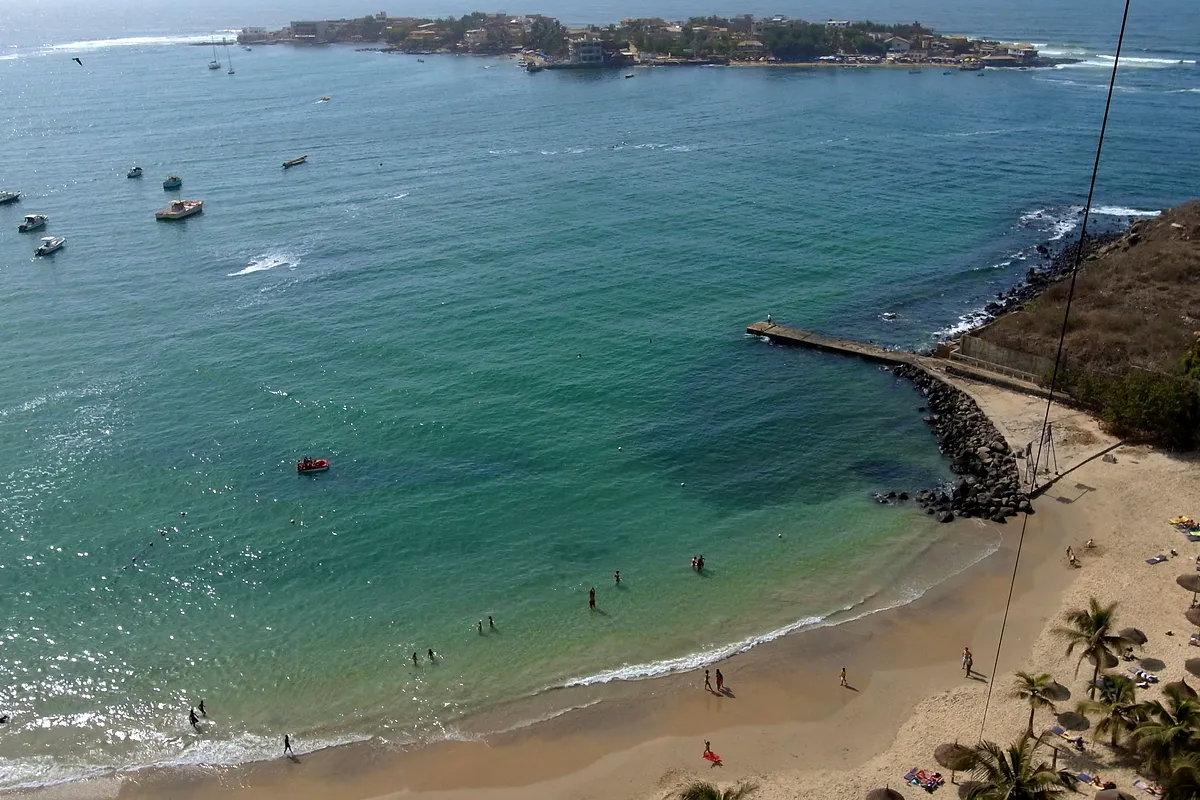
The breaks
Recognised, publicly known surf spots around Busua. Suitability depends on the day's swell, wind and tide, so treat the level as a guide, not a guarantee.
| Break | Type | Best for | Notes |
|---|---|---|---|
| Busua Beach | Sandy beach break | Beginner–Intermediate | The main surf area, with mostly easy lefts and rights suited to schools. Wave quality is modest, and rips can appear after bigger swell. |
| Busua reef | Right-hand reef | Intermediate | A reef section beside the beach described by forecast sites, with rocks as the main hazard. Ask a local before paddling out. |
| Black Mamba | Right-hand point | Advanced | Reached by a paddle of roughly 20 minutes from Busua beach. Details are thin, so go only with a local and respect the distance. |
| Axim | Beach and reef break | Intermediate | An exposed beach and reef west of Busua. Sources disagree about how calm the water is, so check conditions on the day. |
Busua surf climate, measured
Ten years of ocean model data for the open water off this coast: what the swell usually looks like before it reaches the beach. Shelter, sandbars and reefs change what you actually surf, so read this next to the month notes below.
| Month | Swell | Period | From | Wind | Water | Wetsuit | Days over 2.5 m |
|---|---|---|---|---|---|---|---|
| Jan | 1.1 m | 11 s | S | 10 km/h SW | 28°C | Boardshorts | 0% |
| Feb | 1.1 m | 11 s | S | 10 km/h SW | 28°C | Boardshorts | 0% |
| Mar | 1.2 m | 11 s | S | 14 km/h SW | 28°C | Boardshorts | 0% |
| Apr | 1.3 m | 12 s | S | 12 km/h SW | 29°C | Boardshorts | 0% |
| May | 1.4 m | 12 s | S | 11 km/h SW | 29°C | Boardshorts | 0% |
| Jun | 1.6 m | 12 s | S | 14 km/h S | 28°C | Boardshorts | 0% |
| Jul | 1.5 m | 12 s | S | 15 km/h SW | 25°C | Boardshorts | 0% |
| Aug | 1.5 m | 12 s | S | 16 km/h SW | 24°C | Rash vest or 1 mm top | 3% |
| Sep | 1.5 m | 12 s | S | 14 km/h SW | 25°C | Boardshorts | 0% |
| Oct | 1.3 m | 11 s | S | 13 km/h SW | 27°C | Boardshorts | 0% |
| Nov | 1.3 m | 11 s | S | 10 km/h S | 29°C | Boardshorts | 0% |
| Dec | 1.1 m | 11 s | S | 8 km/h SW | 29°C | Boardshorts | 0% |
Median values from ERA5 at a sea point near Busua (4.75°N, 2°W), sampled 4 days a month at 12:00 UTC, 2015-2024. Highlighted months are our suggested planning window. Not a forecast or a safety assessment. How we use this data.
Book a surf trip to Busua
Everything we can link you to for this trip, grouped by what you need. Before you pay a camp or school, read who holds your money, and check that your insurance covers surfing.
Where to stay
Search near the breaks. Filter for surf hostels, apartments or hotels once you can see the map.
Surf lessons and activities
Listings change by season, so check what the operator includes and who coaches.
Flights
Add your dates and check the board fee on every leg before you pay.
Car hire
Ask about roof racks and whether the insurance covers boards on the roof.
Airport transfer
Tell the driver you have a board and its length when you book.
Mobile data
Download a forecast app and offline maps before you land.
Flight delay claims
If a delay eats your first surf day, check whether you can claim.
Luggage storage
Useful between check-out and a late flight. Check the size limit before dropping a board.
Links marked as partner links may earn us commission at no cost to you; the rest earn us nothing. We have not checked live availability or price, and the seller's terms apply. How we handle this.
Cheapest months to fly to Busua
Lowest return fare to ACC that Aviasales users found recently, in US dollars. Treat these as a guide to which months are cheaper, not as prices you can book today.
| From | Nov 26 | Dec 26 | Jan 27 | Feb 27 | Mar 27 | Aug 27 |
|---|---|---|---|---|---|---|
| London | $698 | $861 | $760 | $838 | $830 | $967 |
| New York | $843 | $643 | $643 | $626 | – | $1384 |
| Los Angeles | – | – | – | $1392 | – | – |
| Frankfurt | $741 | $1390 | $685 | – | – | – |
Prices seen by 1 November 2026. Travelpayouts Data API. Board fees are extra on most airlines: see our surfboard baggage guide.
A fishing village on the Gulf of Guinea
Busua is a beach resort and fishing village in Ghana's Western Region, in the Ahanta West District, around 30 kilometres west of the regional capital Sekondi-Takoradi. Wikipedia gives a population of about 5,000 and notes the village's reputation for blue marlin and tuna fishing. Residents are mainly Akan people who speak the Ahanta dialect.
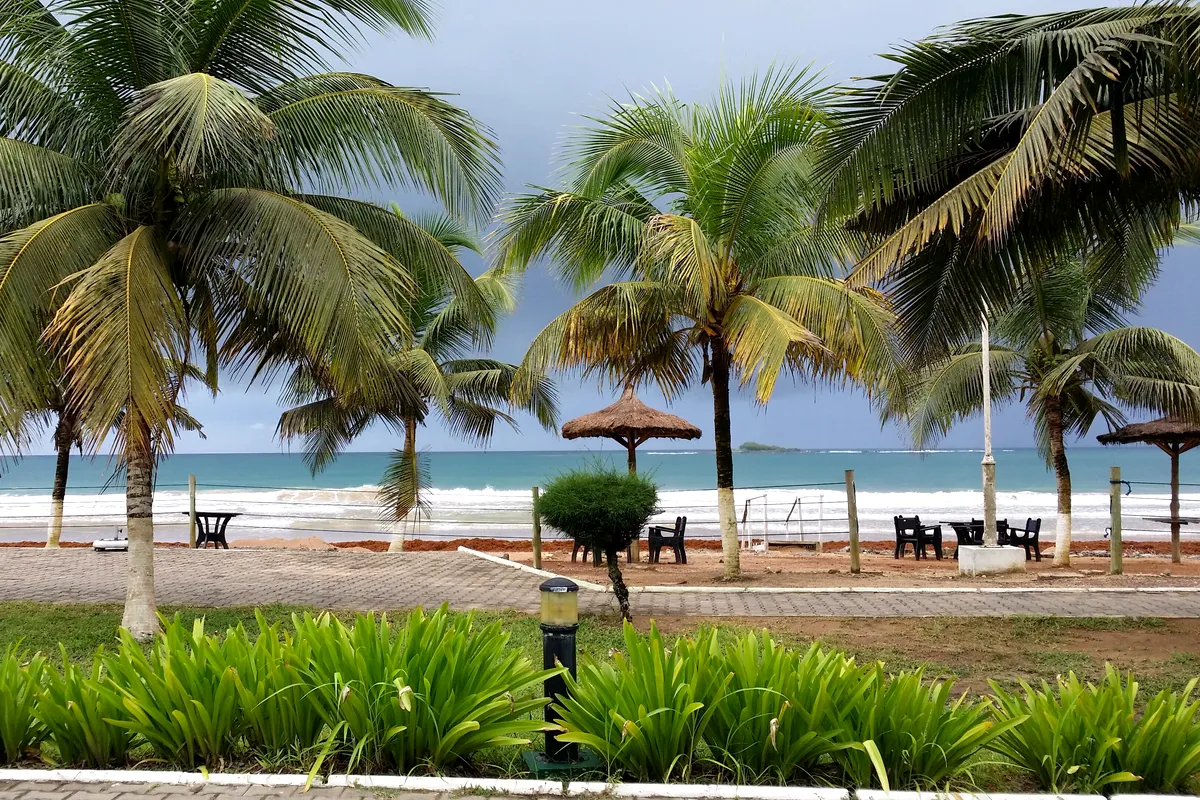
Until the 1960s, well-off people from Sekondi-Takoradi came here on holiday, and some European visitors followed in the 1970s and 1980s, though the village had no electricity or running water until the late 1990s. A palm disease killed the local coconut trees in the early 1990s. Today electricity is fully connected, and there are restaurants, cottages and bungalows along the beach.
The feel is that of a working village rather than a resort. Canoes launch from the sand, children play football on the beach and the pace is slow. For surfers that means friendly neighbours, simple food and a good chance of meeting locals in the water.
What the waves are like
Sources agree that Busua is Ghana's surf centre. Surfnerd describes a sandy beach break with mostly easy waves and both lefts and rights, suited to surf schools and to locals working on their surfing. Surf-Forecast adds a right-hand reef break and warns about rocks, and rates the overall quality modestly, with a difficulty of 2.5 out of 5. Another beach guide calls it a consistent left-hand break. In other words, the details differ by source and by day.
For most visitors the practical summary is simple. Expect a sandy, forgiving beach break most of the time, a small reef section to one side, and waves of a size that allow beginners to learn on the right day. This is not a place for tubes or long point rides, but it is a good place to get comfortable and to log hours.
The water is warm, so the usual kit is boardshorts and a rash vest. Foam boards and longboards make the most of small, soft surf, and a short-board crowd may be rare.
Black Mamba: the point down the coast
For more advanced surfers, one guide mentions a right-hand point break called Black Mamba, reached by a paddle of around 20 minutes from Busua beach. That distance is a clue to the commitment: you are paddling away from the beach, over unfamiliar water, to a wave that may break over rock.
I could not verify its conditions in detail, so use it as a lead rather than a plan. Ask local surfers and the schools about the best swell, the tide, where to enter and how to get back if the current pushes you off. Do not go alone, and do not assume that a nearby boat can pick you up.
Axim, further west, is described by Surf-Forecast as an exposed beach and reef break with dependable surf, while another source says the water at Axim Beach is much calmer than other Ghanaian beaches, with fewer strong currents. Those two statements do not fit together easily, so ask on arrival.
Seasons: what is known and what is not
Season advice for Busua is conflicted. Surf-Forecast says the surf tends to be best in the spring and that the ideal setup is a south-south-west swell with a northerly offshore wind. Surfnerd suggests a southerly swell is usually best with a north-west offshore. A local beach guide advises avoiding October and November because of strong swell and rip-current risk. I did not find clear wet-versus-dry-season guidance specific to surf.
What I can say is that Ghana has a tropical climate with wet and dry seasons, and that the south-west is hot and humid. Heavy rain affects roads and water quality, so it is sensible to check conditions before travelling long distances. The sea remains warm all year.
The pragmatic approach is to treat the calendar as provisional. Choose a window that suits your own travel constraints, bring a flexible attitude and ask a school what the water has done recently. If the surf is small, you can still enjoy the beach, the fishing boats and the forts.
Rip currents and beach safety
Wikipedia describes a long sandy beach at Busua with no dangerous currents, but the British government warns that swimming is dangerous on Ghana's southern coast because of rip tides and undertows, with occasional deaths. Both statements can be true on different days. The safest assumption is that currents can appear anywhere, particularly after a bigger swell.
Follow what the local surfers and fishermen do. Keep clear of channels where water pulls seaward, avoid going out alone, and do not rely on lifeguards being present. If you are caught in a rip, stay calm, keep hold of your board, paddle parallel to the beach and signal for help.
Theft is the main other beach issue. The same advice says isolated violent crime and sexual assault have occurred in tourist areas and tells visitors not to visit beaches alone. Leave valuables at the guesthouse and avoid empty beaches after dark.
The long road from Accra
Busua is far from the capital. Most travellers fly to Accra's Kotoka International Airport, then continue west by road or by a domestic flight to Takoradi. From Takoradi, Busua is about 30 kilometres by road, so the final leg is manageable.
The British government warns that road conditions are often poor, especially in rural areas, that street lighting is poor or absent and that police checkpoints can appear without warning at night, so avoid travelling by road outside main towns after dark. Use licensed or pre-booked taxis, and note that tro-tros and app-based taxis are not centrally licensed. For longer trips outside cities, the advice is to travel in daylight, in a convoy of at least two vehicles, and not to stop for people flagging you down.
Kidnapping of foreign nationals has been reported in Accra, Takoradi and Kumasi, so confirm your driver's identity at arrivals and arrange transport in advance. Plan to arrive in Busua before dark, even if that means breaking the journey.
Dixcove, Axim and the Dutch and British forts
The coast around Busua is dotted with forts built by European traders. Dixcove, a fishing village about a 25-minute walk west, has the old British Fort Metal Cross. Fort Batenstein, a former Dutch fortress, lies to the east. Axim, to the west, has Fort St Anthony, which the Dutch built after capturing the town in 1642.
These places belong to a difficult history of trade and slavery, and they are worth visiting with a local guide who can explain what happened. Smaller fishing communities along the road offer a glimpse of daily life and the importance of the sea.
Fishing canoes launch and land on the beach, and nets and lines stretch across the sand. Treat those as working space, stay out of the way and buy fresh fish from the people who bring it in.
Costs, comforts and the right mindset
Busua is cheaper than most surf destinations in Europe, with simple guesthouses, beach cottages and small restaurants that serve grilled fish, jollof rice and fresh fruit. A mid-range traveller can expect a modest budget, though prices change and tourist places raise them in peak weeks, so treat any quote as indicative.
Electricity is connected, but outages happen, and mobile data is patchy. If you plan to work remotely, check coverage on arrival and carry a power bank. Bring cash in small notes, because card machines are rare outside Accra, and keep a copy of your passport photo page.
The right mindset helps. This is a place to take a slow week, learn on a soft wave and be a respectful guest. It is not a place to chase perfect conditions or to expect a polished tourist infrastructure.
Busua surf season month by month
A broad planning picture, not a forecast. Swell, wind and water temperature vary from year to year.
| January | Hot, humid and warm-watered. Surf information for this month is thin, so ask a local school what to expect and treat any forecast as provisional. |
|---|---|
| February | Warm sea and small to moderate surf is typical of the coast, though sources give little month-specific detail. Good for lessons if the swell is gentle. |
| March | Spring is named by one forecast site as the best surf period, with south-south-west swell and northerly offshores. Heat and humidity build. |
| April | Still within the period described as best for surf, but rain becomes more likely and roads can deteriorate. Check weather before travelling. |
| May | Part of the wetter period for southern Ghana in most climate summaries. Heavy rain can affect roads and water quality, so check conditions before the long journey. |
| June | Rain is likely and the sea stays warm. Surf data for this month is thin, so rely on local advice and allow extra time for road travel. |
| July | Wet-season weather is common on this coast, and I found no reliable surf detail for the month. Take extra care with currents and ask before entering the water. |
| August | Climate summaries describe the south-west as hot and humid, with cloudier spells. Surf information is limited, so check with a school on arrival. |
| September | A transitional month with variable weather. Conditions are poorly documented, so rely on local advice about currents and wave size before going out. |
| October | One local beach guide advises avoiding October and November because of strong swell and rip-current risk. Take extra care or skip the surf. |
| November | Similar caution applies as in October, with stronger swell and rips reported. Ask a school what the water is doing before entering. |
| December | Warm days and a busy holiday period for the village. Surf information is thin, so book ahead and ask a school how the water has been behaving. |
Learning to surf in Busua
Busua is the best-known place in Ghana to take lessons. Several schools operate on the beach and offer group sessions of around 90 minutes to two hours, usually with a board and a wetsuit or rash vest included. Some schools also offer simple accommodation near the sand. Quality and safety standards vary, so ask questions before you pay.
Good questions include how many students each instructor takes, whether instructors are trained in first aid and rescue, how they identify rips and what they do when the swell rises. A reputable school will answer directly and will tell you if the sea is too rough.
The soft waves and warm water make Busua a forgiving classroom, but the British government's warning about rip tides on the southern coast applies. Stay in the zone the instructor shows you, and do not swim or surf alone in the evening.
Comparing options across the country? Read our guide to surfing in Ghana.
Seasonal notes on this page describe typical patterns, not the conditions on a given day. Use the local forecast, lifeguard advice and a qualified instructor for water-safety decisions, and get a written breakdown of what any surf package includes before paying.
Busua surf trip questions
Is Busua good for beginners?
It can be. The sandy beach break, warm water and local schools make it a reasonable place to learn, though quality is modest and rip currents are a risk. Always go with an instructor.
When is the best time to surf in Busua?
Sources disagree. Spring is named by one forecast site as best, while a local guide advises avoiding October and November for strong swell and rips. Ask a school what the sea has been doing.
How do I get to Busua from Accra?
By a long road journey or a domestic flight to Takoradi, then about 30 kilometres by road. Use pre-booked transport, travel in daylight and avoid night driving.
Do I need a wetsuit in Busua?
Not for warmth. The water is warm all year, so boardshorts and a rash vest are usual. Schools may provide wetsuits to protect against board rash.
Is Busua safe?
The village is small and friendly, but the British government warns of beach theft, isolated violent crime and rip tides on the southern coast. Do not go to beaches alone, and keep valuables out of sight.
What is Black Mamba?
A right-hand point break reached by a paddle of about 20 minutes from Busua beach, described as an option for advanced surfers. Details are thin, so only go with a local.
Sources & editorial notes
Destination context checked against the sources below. Base-selection and itinerary suggestions are Book & Surf editorial recommendations. Seasonal windows are broad planning suggestions, not measured forecasts or guarantees.
- Wikipedia: Busua ↗
- UK Government: Ghana safety and security ↗
- Surf-Forecast: Busua Beach ↗
- Surfnerd: Busua Beach forecast ↗
We do not claim to have personally surfed every break. Read our editorial standards.