The breaks
Recognised, publicly known surf spots around Malibu. Suitability depends on the day's swell, wind and tide, so treat the level as a guide, not a guarantee.
| Break | Type | Best for | Notes |
|---|---|---|---|
| First Point (Surfrider Beach) | Right-hand point | Beginner–Intermediate | The classic Malibu longboard wave. Slow and forgiving but very crowded; watch for loose boards and keep to etiquette. |
| Second Point | Right-hand point | Intermediate–Advanced | A more performance-oriented section just up the coast. Faster than First Point and often with a skilled crowd. |
| Third Point | Left and right point | Intermediate | Offers both a left and a right. On south swells the ride can run all the way to the pier. |
| Zuma Beach | Beach break | Beginner–Intermediate | A long county beach with lifeguards and large parking lots. A common choice for lessons; watch for shore dump on bigger swells. |
| Topanga State Beach | Point/beach | Intermediate | A rocky point at the southern end of Malibu that works best on south swells. Fewer people than Surfrider on many days. |
| Leo Carrillo State Beach | Beach/reef | Intermediate | Near the county line with rocky coves and tide pools. Check the tide before paddling out. |
Full profile: Malibu First Point.
Malibu surf climate, measured
Ten years of ocean model data for the open water off this coast: what the swell usually looks like before it reaches the beach. Shelter, sandbars and reefs change what you actually surf, so read this next to the month notes below.
| Month | Swell | Period | From | Wind | Water | Wetsuit | Days over 2.5 m |
|---|---|---|---|---|---|---|---|
| Jan | 0.9 m | 13 s | W | 10 km/h N | 15°C | 4/3 mm full suit | 0% |
| Feb | 0.8 m | 13 s | W | 9 km/h N | 15°C | 4/3 mm full suit | 0% |
| Mar | 0.9 m | 12 s | W | 7 km/h NE | 15°C | 4/3 mm full suit | 0% |
| Apr | 1.0 m | 13 s | W | 7 km/h NE | 15°C | 4/3 mm full suit | 0% |
| May | 0.9 m | 13 s | SW | 6 km/h E | 16°C | 3/2 mm full suit | 0% |
| Jun | 0.9 m | 14 s | SW | 6 km/h SE | 18°C | 3/2 mm full suit | 0% |
| Jul | 0.8 m | 14 s | SW | 4 km/h E | 20°C | 2 mm shorty or spring suit | 0% |
| Aug | 0.8 m | 12 s | SW | 4 km/h SE | 21°C | 2 mm shorty or spring suit | 0% |
| Sep | 0.8 m | 13 s | SW | 4 km/h NE | 20°C | 2 mm shorty or spring suit | 0% |
| Oct | 0.8 m | 13 s | SW | 7 km/h NE | 19°C | 2 mm shorty or spring suit | 0% |
| Nov | 0.8 m | 12 s | W | 10 km/h N | 18°C | 3/2 mm full suit | 0% |
| Dec | 0.8 m | 13 s | W | 10 km/h N | 16°C | 3/2 mm full suit | 0% |
Median values from ERA5 at a sea point near Malibu (34°N, 118.75°W), sampled 4 days a month at 12:00 UTC, 2015-2024. Highlighted months are our suggested planning window. Not a forecast or a safety assessment. How we use this data.
Book a surf trip to Malibu
Everything we can link you to for this trip, grouped by what you need. Before you pay a camp or school, read who holds your money, and check that your insurance covers surfing.
Where to stay
Search near the breaks. Filter for surf hostels, apartments or hotels once you can see the map.
Surf lessons and activities
Listings change by season, so check what the operator includes and who coaches.
Flights
Add your dates and check the board fee on every leg before you pay.
Car hire
Ask about roof racks and whether the insurance covers boards on the roof.
Airport transfer
Tell the driver you have a board and its length when you book.
Mobile data
Download a forecast app and offline maps before you land.
Flight delay claims
If a delay eats your first surf day, check whether you can claim.
Luggage storage
Useful between check-out and a late flight. Check the size limit before dropping a board.
Links marked as partner links may earn us commission at no cost to you; the rest earn us nothing. We have not checked live availability or price, and the seller's terms apply. How we handle this.
Cheapest months to fly to Malibu
Lowest return fare to LAX that Aviasales users found recently, in US dollars. Treat these as a guide to which months are cheaper, not as prices you can book today.
| From | Nov 26 | Dec 26 | Jan 27 | Feb 27 | Mar 27 | Apr 27 |
|---|---|---|---|---|---|---|
| London | $528 | $560 | $578 | $645 | – | $718 |
| New York | $295 | $304 | $254 | $299 | $419 | $374 |
| Sydney | $783 | – | – | $704 | $733 | – |
| Frankfurt | $595 | $638 | $682 | $615 | – | $621 |
Prices seen by 1 November 2026. Travelpayouts Data API. Board fees are extra on most airlines: see our surfboard baggage guide.
Surfrider Beach and the first World Surfing Reserve
Surfrider Beach is the surfing name for the beach beside Malibu Lagoon State Beach, close to Malibu Pier. In October 2010 it was dedicated as the first World Surfing Reserve, a designation meant to recognise outstanding waves and the culture and ecology around them. The wave is a right-hand point over a cobblestone and sand bottom, and it is widely regarded as a model of a smooth summertime point.
The breaks are labelled First, Second and Third Point from the pier side up the coast. Third Point has both a left and a right and, on south swells, can link up to the pier. The shoreline is usually triple-cornered because sand, silt and cobble pile up at the creek mouth, which is why the wave breaks the way it does.
Who surfs First Point, and how
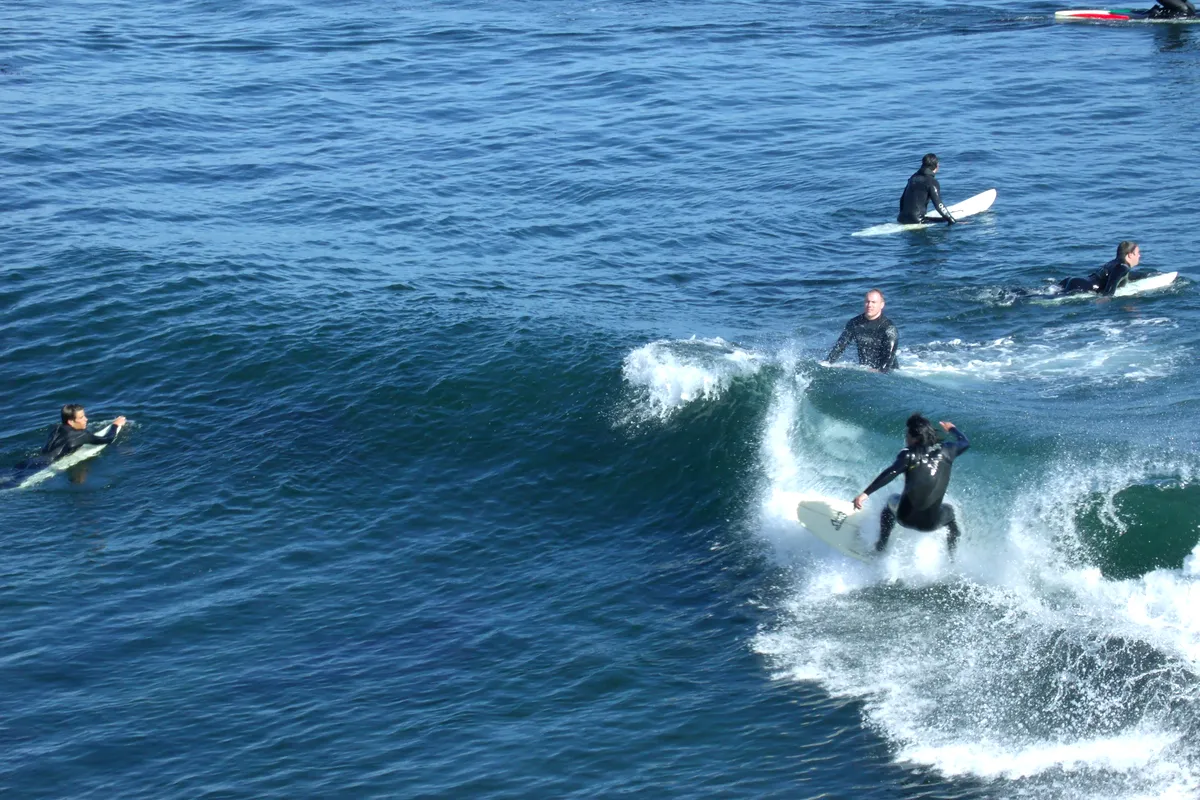
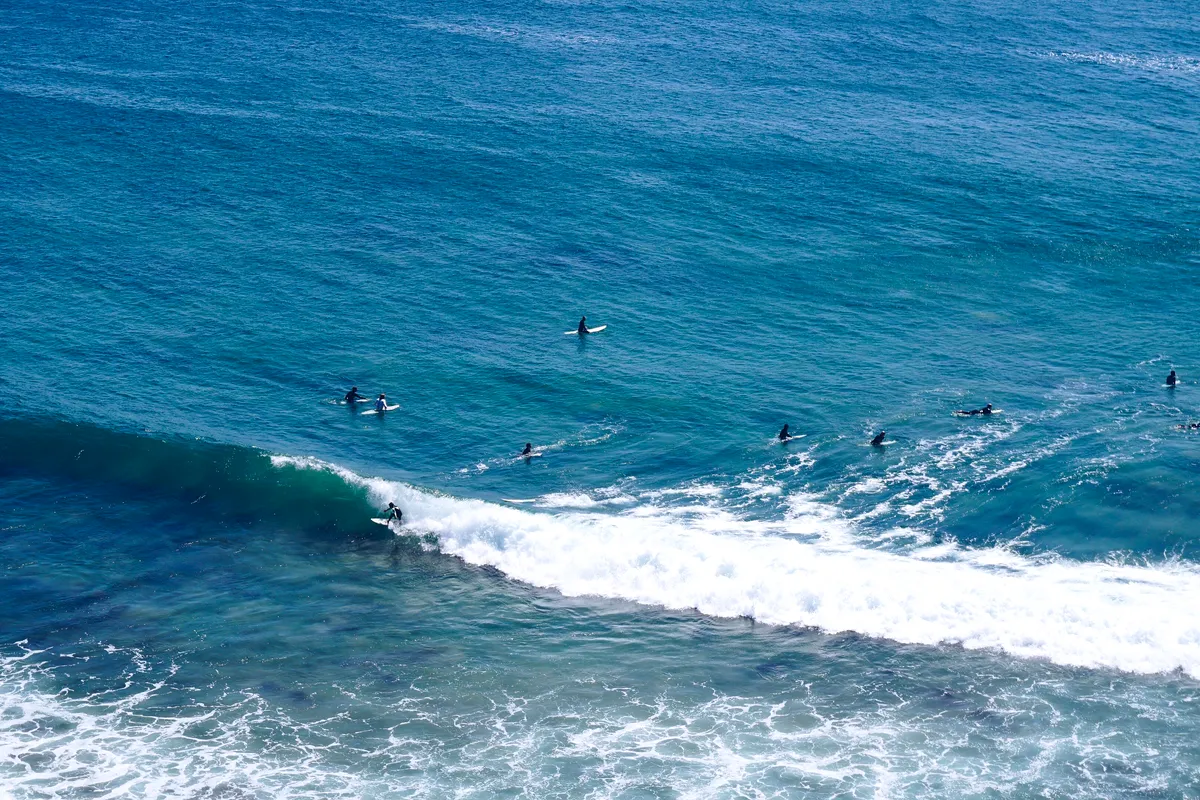
First Point is the classic longboard wave, with a long, forgiving face that suits noseriding and a lineup crowded with skilled surfers and, on a summer weekend, a large share of Los Angeles. Second Point works more for high-performance surfing, and Third Point is more open and can be fast.
With so many people in the water, etiquette is everything. Wait your turn, never drop in and do not paddle around the pack to the inside. Beginners and intermediates should avoid First Point on a busy weekend morning and pick a smaller beach break instead. Weekdays and early mornings are friendlier. The wave is mellow, but loose boards are dangerous in a crowded lineup, so control your board.
Zuma, Topanga, Leo Carrillo and the other beaches
Malibu has more than one wave. Zuma Beach, in the north of the city, is a long beach break with a lifeguard presence and plenty of parking, which makes it a standard choice for learners and families. Topanga State Beach, at the southern end, is a point wave that can be a good longboard option on south swells.
Leo Carrillo State Beach, near the Ventura County line, offers rocky coves, tide pools and a sand-bottom surf area. Point Dume is a rocky headland that gives some shelter from northwesterly winds. These locations are all different in character, so you can move along the coast depending on swell direction and tide. Check the beach before paddling out, since rocks and kelp can be exposed at low tide.
Water quality, wildlife and wildfire
Malibu Lagoon is an estuary at the mouth of Malibu Creek, and its restoration is a joint project by several agencies. Migratory birds use the lagoon and snowy plovers nest on the beach, which is why some areas are fenced off in the breeding season. Keep to marked paths and respect the signs.
After heavy rain, runoff from creeks and storm drains can lower water quality at Surfrider and other beaches. Local advisories usually recommend avoiding the water for a few days after a storm, and it is sensible to follow them. Wildfires have burned parts of the Santa Monica Mountains in recent years, so before a trip check which roads, parks and beaches are open.
Parking, the Pacific Coast Highway and the drive from LAX
Almost every visit to Malibu involves the Pacific Coast Highway, a busy two- to four-lane road with limited alternatives. The drive from LAX is about 25 miles and takes around 45 minutes in light traffic, but it can be an hour and a half or more at rush hours and on summer weekends. Parking at Surfrider is a mixture of paid lots and roadside spots, with strict signage.
If you do not have a car, it is possible to reach Malibu by bus from Santa Monica, but a car or ride share is much easier with a board. Arrive early on weekends, check signs carefully for time limits, and avoid blocking driveways. Some of the beach accesses are through narrow public paths between private houses.
Where to stay on this stretch of coast
Malibu is a high-cost area with limited accommodation, and many visitors stay in Santa Monica, Venice or the coastal towns of the South Bay and drive up. This adds time to the day but gives access to more places to eat and a wider range of prices. Others choose Ventura County towns north of Malibu, which are quieter and cheaper.
If you do stay in Malibu, expect to pay more than elsewhere in Southern California and to book far ahead for summer weekends. Short-term accommodation rules vary by city, and availability changes, so check current options rather than assuming. The local restaurants and cafes cluster near the pier and along Pacific Coast Highway.
Summer south swells, winter north-westerlies
Malibu's best-known waves are summer waves. South swells from storms in the Southern Hemisphere arrive in the warmer months, with the most reliable runs in late August and September, and they wrap around the point to give the long, clean rides that made the place famous. Winter brings north-west swells, but the angle often means that Malibu works less well, and other breaks along the coast take over.
Winds are typically light in the morning and onshore in the afternoon, so plan to surf early. The marine layer can leave mornings grey in early summer, and the sun usually breaks through by lunchtime. Water temperatures range from the mid-teens in winter to the high teens or low twenties Celsius in late summer, so many surfers wear a spring suit or a 3/2.
Malibu surf season month by month
A broad planning picture, not a forecast. Swell, wind and water temperature vary from year to year.
| January | Cool water and clear winter days. North-west swell arrives, but Malibu works less well; other beaches along the coast may be better. |
|---|---|
| February | Variable weather with some rain. Check water quality after storms and be ready for chilly mornings in a 4/3. |
| March | Spring winds start to pick up and swells are mixed. Crowds are lighter than in summer, and the water remains cool. |
| April | Mixed conditions, with the first signs of south swell towards the end of the month. Early sessions are best for avoiding wind. |
| May | Marine layer mornings and building south swell. Water is still cool, so a 3/2 or 4/3 is usual. |
| June | The summer season begins. South swells appear, crowds grow and the beaches get busy on weekends. A good time for longboarders. |
| July | Warm days and peak crowds. Surf is often small to moderate and best in the early morning before the wind. |
| August | Late summer south swells can produce the best waves of the year at Surfrider, and the water is at its warmest. |
| September | The prime month for many: reliable south swells, warm water and lighter winds. Crowds remain high on weekends. |
| October | Fall swells and offshore winds from the Santa Ana season can improve conditions, though heat and fire risk rise inland. |
| November | Cooling water and a shift to north-west swells. Lineups thin out, and the first winter rain can affect water quality. |
| December | Short days and cool water. Winter swells arrive, and the points often need a south component to work. |
Learning to surf in Malibu
Malibu has several surf schools, and most lessons take place at Zuma Beach, at Surfrider on small days, or at quieter beaches to the north. The long, soft waves at First Point suit beginners in principle, but the crowd can make it hard, so many instructors prefer less busy locations.
Lessons typically last around two hours, with wetsuits and foam boards included. In summer the water is cool but comfortable in a spring suit, and in winter you will want a full suit. Ask how many students are with each instructor, and where the school plans to teach on the day.
Once you can pop up and ride the white water, Malibu is a good place to practise trimming a longboard. Stay inside the flagged area when there are lifeguards and respect other surfers' space.
Comparing options across the country? Read our guide to surfing in the USA.
Seasonal notes on this page describe typical patterns, not the conditions on a given day. Use the local forecast, lifeguard advice and a qualified instructor for water-safety decisions, and get a written breakdown of what any surf package includes before paying.
Malibu surf trip questions
When is the best time to surf in Malibu?
Late summer, from August to September, usually brings the most reliable south swells and warm water. Summer is also the busiest period at Surfrider Beach.
Is Malibu good for beginners?
It can be, with a school, but Surfrider is crowded. Many instructors teach at Zuma or at quieter beaches, where the waves are soft and there is more space.
What is a World Surfing Reserve?
It is a designation for outstanding surf zones and the surrounding environment and culture. Surfrider Beach in Malibu was dedicated as the first one in October 2010.
Is the water clean at Malibu?
It is generally fine, but runoff from creeks and storm drains can reduce quality after heavy rain. Local advisories recommend staying out for a few days after a storm.
How long does it take to drive from LAX to Malibu?
About 45 minutes with little traffic, but an hour and a half or more at rush hour or on summer weekends. Plan to arrive early for parking at the popular breaks.
Sources & editorial notes
Destination context checked against the sources below. Base-selection and itinerary suggestions are Book & Surf editorial recommendations. Seasonal windows are broad planning suggestions, not measured forecasts or guarantees.
- Wikipedia: Malibu Lagoon State Beach ↗
- Wikipedia: Malibu, California ↗
- Save The Waves Coalition: World Surfing Reserves ↗
We do not claim to have personally surfed every break. Read our editorial standards.