The breaks
Recognised, publicly known surf spots around Tofo. Suitability depends on the day's swell, wind and tide, so treat the level as a guide, not a guarantee.
| Break | Type | Best for | Notes |
|---|---|---|---|
| Tofo Beach | Beach break | Beginner–Intermediate | Lefts and rights over sand, typically 2 to 4 feet in the dry season, with some closeouts. The main teaching beach, and busy with boats and snorkellers. |
| Tofinho | Right-hand reef/point | Intermediate–Advanced | Peeling rights at the southern end of the beach that can give short tubes. Wind-sensitive and unreliable, so dawn sessions are best. |
| Barra | Sheltered beach break | Beginner | At the northern end of the peninsula. Needs a strong southerly or rare northerly swell, and is used by schools when Tofo is too big. |
| Guinjata Bay | Beach and point break | All levels | A swell magnet with mostly right-hand walls, 3 to 5 feet on average and larger in big swells. Reached by sand track. |
| Dino's Left | Left-hand point | Intermediate–Advanced | A consistent left near Guinjata Bay described as Indo-style. Remote, so go with a local and take care with the tide. |
| Jangamo Beach | Point break | Intermediate | About a kilometre from Guinjata Bay. Fairly consistent on south-east swell with a west offshore wind. |
Tofo surf climate, measured
Ten years of ocean model data for the open water off this coast: what the swell usually looks like before it reaches the beach. Shelter, sandbars and reefs change what you actually surf, so read this next to the month notes below.
| Month | Swell | Period | From | Wind | Water | Wetsuit | Days over 2.5 m |
|---|---|---|---|---|---|---|---|
| Jan | 1.2 m | 8 s | SE | 21 km/h SE | 28°C | Boardshorts | 3% |
| Feb | 1.1 m | 9 s | SE | 19 km/h E | 28°C | Boardshorts | 5% |
| Mar | 1.2 m | 9 s | SE | 20 km/h SE | 28°C | Boardshorts | 5% |
| Apr | 1.1 m | 9 s | SE | 18 km/h SE | 27°C | Boardshorts | 0% |
| May | 1.0 m | 9 s | SE | 15 km/h SE | 26°C | Boardshorts | 0% |
| Jun | 1.1 m | 8 s | SE | 16 km/h SE | 24°C | Rash vest or 1 mm top | 0% |
| Jul | 1.0 m | 9 s | SE | 18 km/h SE | 23°C | Rash vest or 1 mm top | 0% |
| Aug | 1.1 m | 8 s | SE | 18 km/h NE | 23°C | Rash vest or 1 mm top | 0% |
| Sep | 1.1 m | 8 s | SE | 21 km/h NE | 24°C | Rash vest or 1 mm top | 0% |
| Oct | 1.1 m | 8 s | SE | 21 km/h E | 25°C | Boardshorts | 3% |
| Nov | 1.1 m | 8 s | SE | 22 km/h NE | 26°C | Boardshorts | 3% |
| Dec | 1.0 m | 8 s | SE | 21 km/h E | 27°C | Boardshorts | 0% |
Median values from ERA5 at a sea point near Tofo (23.75°S, 35.5°E), sampled 4 days a month at 12:00 UTC, 2015-2024. Highlighted months are our suggested planning window. Not a forecast or a safety assessment. How we use this data.
Book a surf trip to Tofo
Everything we can link you to for this trip, grouped by what you need. Before you pay a camp or school, read who holds your money, and check that your insurance covers surfing.
Where to stay
Search near the breaks. Filter for surf hostels, apartments or hotels once you can see the map.
Surf lessons and activities
Listings change by season, so check what the operator includes and who coaches.
Flights
Add your dates and check the board fee on every leg before you pay.
Car hire
Ask about roof racks and whether the insurance covers boards on the roof.
Airport transfer
Tell the driver you have a board and its length when you book.
Mobile data
Download a forecast app and offline maps before you land.
Flight delay claims
If a delay eats your first surf day, check whether you can claim.
Luggage storage
Useful between check-out and a late flight. Check the size limit before dropping a board.
Links marked as partner links may earn us commission at no cost to you; the rest earn us nothing. We have not checked live availability or price, and the seller's terms apply. How we handle this.
A peninsula town at the end of a sand road
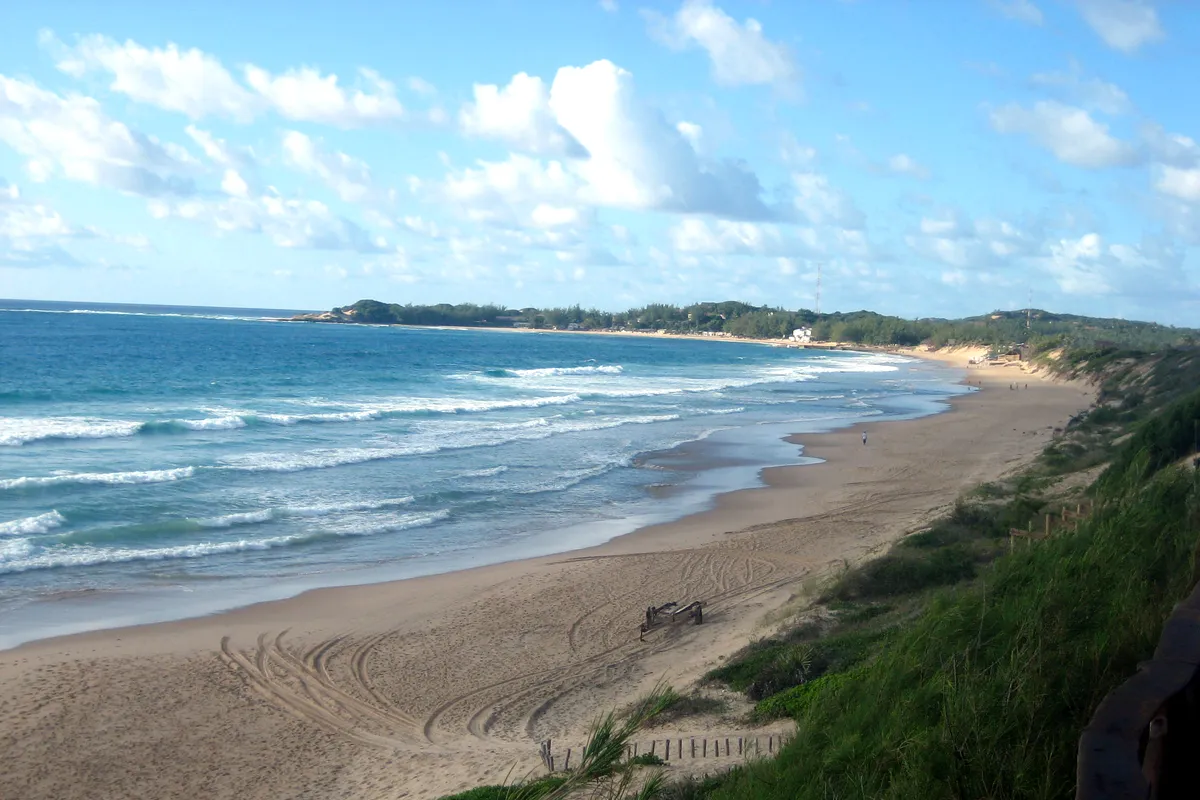
Tofo, or Praia do Tofo, is a small town in south-eastern Mozambique on the Barra Beach peninsula, in Inhambane Province. Wikipedia gives an approximate population of 15,000 and places it a drive of around 20 kilometres from Inhambane city, though the sources I checked give slightly different distances.
The town grew up around fishing and then around tourism, and today it is known more for marine life than for waves. Its streets are mostly sand, its buildings low and its visitors a mix of travellers on a budget, divers, volunteers and South African families. The atmosphere is relaxed and a little scruffy, with beach bars, small lodges and fish markets close together.
That suits some people very well. If you want a polished resort, this is not it. If you want a place where you can walk to the beach, find a lesson and have dinner at a table on the sand, it is close to ideal.
The dry-season swell calendar
Wikipedia describes a wet season from October to March and a dry season from April to September in Mozambique. Surf sources for Tofo agree that the dry season is the surf season, with May to September named as the peak in one guide and April to early October in another. Swell comes from the south-east and east, generated in the southern Indian Ocean, and offshore winds are typically from the west.
Tofo Beach itself can work on swells from north-east through east-south-east to south, with south-east usually best according to Surf-Forecast. Tofinho prefers a south to south-east swell with a north-west to west offshore wind. Both are sensitive to wind, and dawn is the most reliable window.
The wet season, from roughly October to March, is humid, rainy and exposed to tropical cyclones, with Cyclones Idai and Kenneth in 2019 and Freddy in 2023 listed as recent examples. Many visitors avoid it, partly for weather and partly because the best waves are in the dry months.
Tofo Beach: the learning wave
The main beach is the heart of the surf scene. It is a beach break with both lefts and rights, with some closeouts, and a typical size of 2 to 4 feet on a dry-season day according to a regional guide. Most local schools teach here, and it is regarded as fantastic beginner territory when the banks are right.
The key to enjoying it is to read the peaks. Sandbanks move after storms, so the best waves can be a few hundred metres from where they were last week. A good instructor will choose a peak that is breaking cleanly rather than the closest one to the lodge.
Tofo Beach can be busy with people and boats. Fishing boats launch and land through the surf, and snorkel and dive operators run through the same area, so stay aware of what is moving around you and give boats wide berth.
Tofinho: the point for intermediates
At the southern end of the beach, Tofinho is a reef and point break with right-hand peelers that can produce short tubes and steeper walls. It is the wave that gets Tofo onto the surf map, and it is best on south to south-east swell with north-west to west offshore wind.
The catch is reliability. Surf sources describe it as not reliable, often not clean and sensitive to wind changes, so it is a dawn-patrol wave rather than one you can count on. When it does work, the line-up is small and the surfers are mostly local and visiting intermediates and above.
There is reef and rock here, so reef booties are sensible, and the entry and exit depend on the tide. If you are unsure, watch for a while, ask a school or a local and choose the smaller days. Beginners should stay on Tofo Beach.
Barra, Guinjata Bay and Jangamo
Barra, at the northern end of the Tofo peninsula, needs a strong southerly swell to wrap in, and it works on rare northerly swells, usually from summer storms. It is not considered a good surf spot, though schools sometimes use it on days when Tofo is too large. Its main appeal is the sheltered water and the quiet.
Guinjata Bay, a short drive away, is described as a swell magnet with mostly right-hand walls, averaging 3 to 5 feet and reaching around 8 feet in big swells, suitable for all levels in the right conditions. Its sandy bottom and sheltered position make it a reasonable place for beginners to learn and progress. Nearby, Dino's Left is a consistent left-hand point break suited to intermediate to advanced surfers. Jangamo Beach, about a kilometre from Guinjata Bay, is another point break with fairly consistent surf and a preference for south-east swell with west offshore winds.
All of these require a vehicle capable of soft sand or a local driver. Do not assume the track is passable at high tide.
Getting to Tofo from Inhambane and beyond
The usual route is to fly to Inhambane airport, where services from Johannesburg are mentioned in a regional guide, then take a taxi or minibus for about 30 minutes to Tofo. Many travellers arrive by road: from Maputo, the EN1 highway takes about seven to eight hours, with a 4x4 recommended, and long-distance buses run to Inhambane where a chapa or taxi covers the last stretch.
The UK government advises that Mozambican roads are poor and that road travel outside major cities should be in daylight on main roads. Fuel supply is unreliable and traffic accidents are common. Carry your original passport, because copies and photos are not accepted at police checkpoints, and expect to be stopped from time to time.
If you drive yourself, take a 4x4, check recovery equipment and do not try beach tracks at high tide. A locally arranged transfer from the airport is often the simplest option for a first visit.
Whale sharks, mantas and marine etiquette
Tofo's marine life is the reason many travellers come. One guide notes that you are always in with a chance of spotting whale sharks between May and July, which coincides with the peak surf period. Manta rays are also associated with the area, and humpback whales pass along the coast in the southern winter.
Surf and snorkel trips can share the same weather window, which is convenient but means busy water. Use licensed operators who follow guidance on distance and numbers of people in the water, never chase or touch animals and do not wear sunscreen that you have not rinsed off before swimming with wildlife if the operator advises against it.
On the surf side, keep clear of boats as they launch through the shorebreak, and remember that this coast has no lifeguards. If you are unsure of a break or a current, take advice from a school.
Safety, health and practical limits
The British government advises that beaches and offshore islands in Mozambique are not policed, and that drinking alcohol on public beaches is illegal. Street crime is common in Maputo and rising elsewhere, sometimes involving knives or firearms, so avoid walking alone at night, do not display cash, jewellery or phones and use bank ATMs rather than street ones. Be especially alert when arriving at or leaving residential properties after dark.
In Inhambane province, landmines may remain in remote areas away from main routes, so get advice from local authorities before going off the main roads. Medical facilities are limited, so travel insurance with medical evacuation is important. Malaria is present in much of the country; ask a travel clinic for current advice well in advance.
Sharks are present in the warm Indian Ocean. They are a low-probability risk, but avoid surfing alone at dawn or dusk, stay out when the water is murky after rain and follow local advice.
Tofo surf season month by month
A broad planning picture, not a forecast. Swell, wind and water temperature vary from year to year.
| January | Hot, humid wet season, with cyclone risk and mostly small or unreliable surf. Most surf travellers stay away. |
|---|---|
| February | Wet season and peak cyclone period. Occasional swell but poor weather, flooding on roads and limited services. Not a surf-travel month. |
| March | The wet season winds down. Conditions remain unsettled, but warm water and few visitors suit those with a flexible schedule. |
| April | The dry season begins and swell starts to build. Surf sources name April as a time when Tofinho can produce some of its best conditions. |
| May | Prime season begins, with south-east swell and offshore winds on many mornings. Whale sharks may be seen from May to July. |
| June | Consistent swell, cooler air and clear skies. A peak month for the beach breaks and the points, with more visitors from South Africa. |
| July | Often named as the peak, with regular swell and cool, dry weather. School holidays bring crowds from Johannesburg and Durban. |
| August | Still in the main season, with steady swell and dry weather. Wind can be strong on some days, so dawn patrols matter. |
| September | The end of the main swell season, with warming water and thinner crowds. A good month for combining surf and sightseeing. |
| October | Transition to the wet season. Swell becomes less reliable, humidity returns and the first heavy rain can arrive. |
| November | Wet season, with heat, humidity and unpredictable weather. The surf is smaller and sporadic, and services may be quieter. |
| December | Hot and humid with holiday-season visitors and cyclone risk. Small surf on most days and long, sunny afternoons for the beach. |
Learning to surf in Tofo
Tofo is a friendly place to learn. Beach-break lefts and rights, warm water and a handful of schools make for an easy first week. The best lesson days are in the dry season, when waves are typically 2 to 4 feet and winds are lighter.
Ask how far the school travels, whether wetsuits or rash vests are provided and how many students each instructor takes. Because beaches are not policed and there are no lifeguards, ask also about rescue equipment and first-aid training. A good instructor will brief you on rips, boats and the shorebreak.
If you have already surfed, the same school can often take you to Guinjata Bay or point breaks when conditions suit, with the transport that those tracks require. Consider adding a morning snorkel or dive to see why the town is also known for marine life.
Comparing options across the country? Read our guide to surfing in Mozambique.
Seasonal notes on this page describe typical patterns, not the conditions on a given day. Use the local forecast, lifeguard advice and a qualified instructor for water-safety decisions, and get a written breakdown of what any surf package includes before paying.
Tofo surf trip questions
When is the best time to surf in Tofo?
May to September, in the southern winter. Swell is most consistent then, and winds are often offshore. April and early October can also work.
Is Tofo good for beginners?
Yes. Tofo Beach has gentle waves for lessons and several schools operate there, though closeouts happen and there are no lifeguards. Tofinho is for intermediates.
How do I get to Tofo?
Fly to Inhambane, then take a taxi or minibus for about 30 minutes. By road from Maputo it is roughly seven to eight hours on the EN1, and a 4x4 is recommended.
Do I need a wetsuit?
Usually not. The Indian Ocean is warm, so boardshorts and a rash vest suit most days. A spring suit can help on cool winter mornings.
Is Tofo safe?
The town is a long way from the northern conflict areas, but beaches are not policed, street crime exists and roads are poor. Follow current government advice and avoid night travel.
Can I see whale sharks in Tofo?
They are often seen between May and July according to one guide, and this overlaps with the surf peak. Use a licensed operator and follow their guidance on distance.
Sources & editorial notes
Destination context checked against the sources below. Base-selection and itinerary suggestions are Book & Surf editorial recommendations. Seasonal windows are broad planning suggestions, not measured forecasts or guarantees.
- Wikipedia: Tofo ↗
- The Surf Atlas: Tofo surf ↗
- UK Government: Mozambique safety and security ↗
- Surf-Forecast: Tofinho ↗
We do not claim to have personally surfed every break. Read our editorial standards.