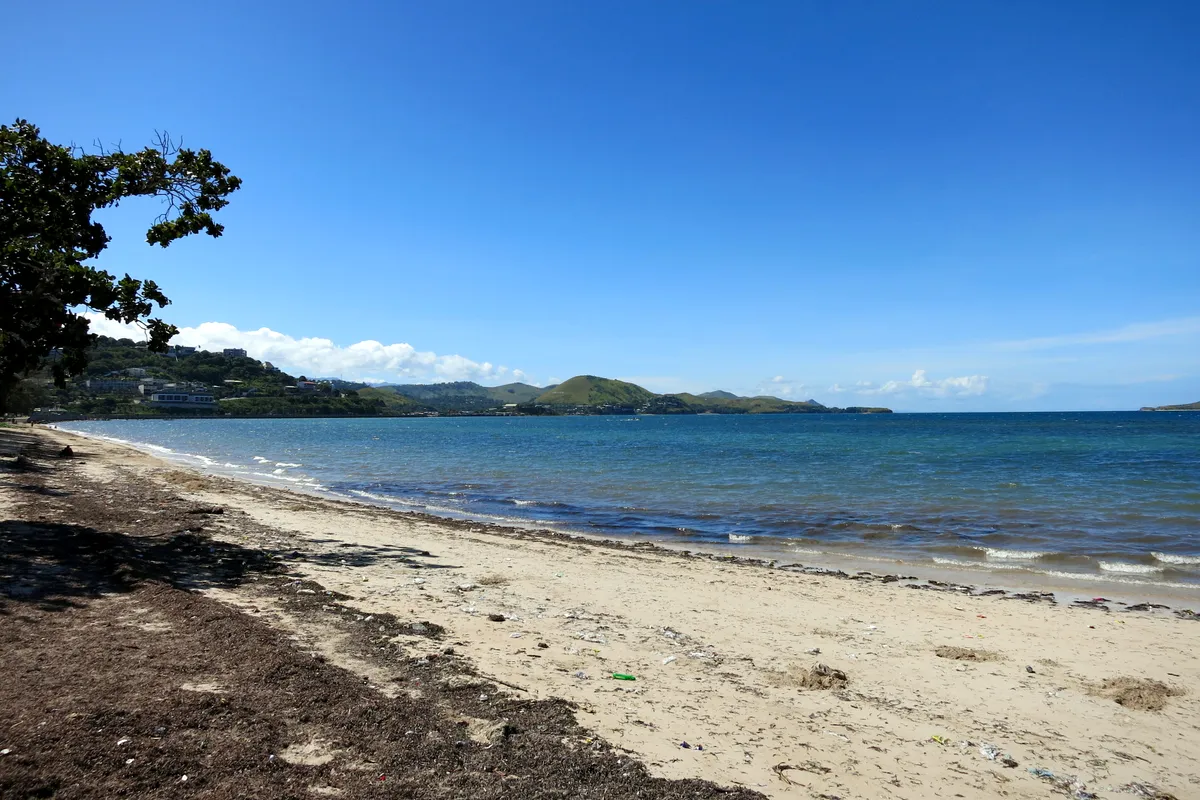
A very large, very diverse country
Papua New Guinea occupies the eastern half of the island of New Guinea together with hundreds of offshore islands, covering about 462,840 square kilometres. The 2024 census counted around 10.2 million people, though other estimates are much higher, and only about 14 percent live in towns. Roughly 840 languages are spoken, which makes it the most linguistically diverse country in the world. English, Tok Pisin and Hiri Motu are official languages, and the currency is the kina.
Most of the economy depends on natural resources, and nearly 40 percent of people work as subsistence farmers. Land is largely held by communities under customary ownership, and that is directly relevant to surfers: the reefs, beaches and villages beside the best waves belong to somebody, and that somebody expects to be consulted.
The result is a country where surf travel feels like an expedition. There are no big beach resorts, no walk-in surf schools and no easy public transport. In return, line-ups are empty by the standards of Bali or Hawaii, and the experience is closer to a visit than to a holiday.
The surf coast and the November to April season
The surf is found mainly on the northern side of the mainland and in New Ireland, where the coast is exposed to north-west monsoon swell and North Pacific swell. Sources vary slightly on the dates. Perfect Wave Travel gives November to April, PNG Surfaris describes October to April, and Wikipedia says mid-October to late April for Vanimo.
Within that window, swell arrives in pulses. One guide describes North Pacific groundswells and north-east trade swells bringing waves of roughly three to six feet, often glassy in the early morning. Local reports from Vanimo quote a range from two to ten feet over the season.
Outside the season the sea is mostly small. The weather is hot and humid year-round, and rain is frequent, so wet conditions are normal rather than a sign of a bad trip.
How surf access is managed
Papua New Guinea's best-known surf destinations use a management system based on agreements with landowners. The Surfing Association of Papua New Guinea (SAPNG) developed a Surf Management Area Plan, described by Al Jazeera in 2013, in which traditional landowners and village elders agree how a reef is used. Visiting surfers paid about 20 kina a day at that time, and SAPNG passed the money to landowners and village stakeholder groups.
Perfect Wave Travel says that SAPNG rules limit surfer numbers and that it is an official preferred member of the association. A 2024 SAPNG brochure lists management areas including Tupira in Madang Province, Kavieng and areas of New Ireland. We could not confirm current fees, caps or booking rules, which may have changed since 2013, so check directly with SAPNG or an operator who works with them.
The same 2013 article records friction: some villagers felt the fee was too low, and some landowners treat particular reefs as their own. The model is not perfect, but it is a deliberate attempt to share benefits with the people whose land and water make the waves possible. As a visitor, your job is to follow it.
Getting there, costs and logistics
Most international visitors arrive in Port Moresby, then take a domestic flight to a regional airport such as Vanimo or Kavieng, or travel by boat from a coastal town. Domestic schedules change, flights can be delayed or cancelled, and baggage allowances for boards vary, so leave buffer days either side of your trip.
Costs are high relative to the facilities. Operators listed by Perfect Wave Travel show prices from about 180 to 270 US dollars at its three listed lodges (the listing does not make the unit clear), and a single live-aboard charter is available that reaches remote reefs across the archipelago, with prices on request. Those figures come from a promotional listing and may be out of date, so treat them as an order of magnitude only.
Cash is useful, and card payments cannot be relied on outside the main towns. Bring spare surf gear, medication and a good first-aid kit, because replacements are very difficult to find.
What a trip looks like in practice
Most surf trips here are organised around a lodge or a charter. A lodge-based stay at Vanimo or Kavieng means a vehicle or boat takes you to a handful of nearby breaks each day, with sessions timed to tide and wind. In Vanimo, one report describes a vehicle that reaches around six breaks within a five-to-ten-minute drive east and west of the lodge, and says that Lido's Right is walkable and a short paddle from the lodge area.
A live-aboard charter is the alternative for covering many reefs, including remote island groups that cannot be reached from shore. Perfect Wave Travel says only one charter operates in the country. Charter schedules are set well in advance and numbers are limited, so enquire months ahead.
Because the available sources are largely promotional or several years old, we recommend asking operators for current information on fees, group limits, health requirements and the status of each management area. A good operator will answer these questions plainly. One that will not is a warning sign. Build the trip around the November to April window, keep your days flexible and expect weather to change plans.
Health and security: the real risks
Malaria and other tropical diseases are a serious concern in coastal Papua New Guinea. See a travel health clinic well before you leave, follow current advice on prophylaxis and bite prevention, and have a plan for medical evacuation. Insurance that covers evacuation from remote areas is strongly advisable.
Security also needs attention. Wikipedia describes persistent violence against women, tribal fighting that has evolved into gang violence, and a history of states of emergency in Port Moresby. Vanimo and Kavieng are smaller and are generally seen differently from the capital, but conditions change, so read your government's current travel advice and follow your host's guidance on movement and transport. Avoid walking alone at night.
In the water, the hazards are reef, distance from medical care and sometimes remote boat access. Surf within your limits and carry reef shoes and basic wound care. A cut that would be trivial at home can become serious when help is hours away.
Etiquette, landowners and the visitor's role
Local people are not extras in someone else's surf trip. The reefs belong to communities, and their consent and benefit are what keep access open. Pay agreed fees, never surf a reef you have not been cleared for, and do not turn up with your own plan and boat.
Behave modestly in villages, ask before photographing people and follow your host's lead on local customs. The Catholic Church is important in some areas, and Pope Francis visited Vanimo on 8 September 2024. Respect for local belief and community structures matters.
Finally, keep the footprint light. Take your rubbish out, avoid single-use plastics where you can and spend money locally. The Al Jazeera report noted that villagers were meant to keep beaches and reefs clear of litter and often did not, which suggests that visitors can help by setting a good example.
Surf regions of Papua New Guinea
Vanimo and Sandaun Province
Vanimo, the capital of Sandaun Province in the north-west, is the country's best-known surf base, with Lido's Right and Left, Freight Trains and Town Beach. Its reputation is for the most consistent waves in Papua New Guinea, and the season runs from about mid-October to late April. Surf is managed under a landowner-agreed plan, with a daily fee and limits on visitor numbers reported by several sources. The town has an airport, a surf lodge and an economy based on timber.
Known for: Vanimo, Lido's Right, Lido's Left, Freight Trains, Town Beach
Kavieng and New Ireland
Kavieng and the east coast of New Ireland make up the most-surfed area of the country, with a range of reef and river-mouth waves. Perfect Wave Travel names Pikinini, Nusa Lefts, Nago Island and Ral Island around Kavieng, and Rubio, Kanons and Bulu on the east coast. Pikinini is described as extremely fast and demanding, with reef boots recommended. Nusa Island Retreat sits about five minutes by boat from Kavieng. The season is roughly October or November to April, and numbers are limited under SAPNG rules.
Known for: Kavieng, Pikinini, Nusa Lefts, Nago Island, Ral Island, Rubio, Kanons, Bulu
Madang Province and the north coast
Further along the north coast, Madang Province is listed in a 2024 SAPNG brochure as home to the Tupira Surf Management Plan area. Other north-coast towns such as Wewak and Madang appear in travel writing, but we found no reliable surf detail for them. Charter boats also reach the Admiralty and St Matthias islands. Treat all of this as remote exploration that needs a local operator and current permission, not a place to improvise.
Known for: Tupira, Madang, Wewak
Learning to surf in Papua New Guinea
Papua New Guinea is not a place to learn. There are no beach-break surf schools in the style of Bali or Portugal, medical help is distant and nearly all the waves break over coral.
That said, some breaks are gentler than others. Vanimo's Town Beach is described as suited to less experienced surfers, and sources say that small to mid-size waves suit all levels in New Ireland, although several breaks are demanding. Even so, the best use of a trip is for people who can already paddle, read a line-up and fall safely onto reef.
If you are new to surfing, take lessons somewhere with sandy beaches and a school network, and add Papua New Guinea once you have a few months of regular surfing behind you.
Surfing in Papua New Guinea: questions
When is the best time to surf in Papua New Guinea?
November to April on most guides, with some placing the start of the season in mid-October. The north coast and New Ireland receive north-west monsoon and North Pacific swells in these months.
How is surfing managed in Papua New Guinea?
Through surf management plans agreed with traditional landowners and coordinated by the Surfing Association of PNG. A 2013 report described a daily fee of about 20 kina passed to landowners and village groups. Check current rules before travelling.
Is Papua New Guinea safe for surf travel?
It needs preparation. Malaria is a concern, medical care is limited and security conditions vary by area. Check your government's travel advice, arrange evacuation insurance and follow your host's guidance.
Where are the best waves in Papua New Guinea?
Vanimo on the north-west coast is known for consistency, and the Kavieng and New Ireland area is the most-surfed region, with waves such as Pikinini and Nusa Lefts. Both are reef breaks.
Is Papua New Guinea good for beginners?
No. Nearly all waves are reef breaks, there are few schools and medical help is distant. Beginners should learn elsewhere first.
Sources & editorial notes
Country context checked against the sources below. Regional summaries are Book & Surf editorial planning suggestions, not forecasts or safety assessments.